Heat Tape for a Mobile Home, and How to Buy the Right Cable
The short version
- Two different products share the name. Chemelex rates its self regulating Frostex at 3 W/ft at 50 F, and that cable needs no thermostat; Frost King rates its constant wattage kits at 7 W/ft, switched on below 38 F and off above 45 F.
- The pipe decides. Frost King answers no for its own kits on mobile home feed lines, and CPSC tells buyers to match the tape to the pipe material, diameter and length.
- Cable goes against the pipe and insulation goes over the top, per CPSC, in fiberglass rather than foam or vinyl, and never more of it than the maker allows.
- The 3 year figure people quote is CPSC advice about uncertified tape. For certified cable the documented duty is a look every fall at the plug, the jacket and the wire.
- The outlet is federal equipment: 24 CFR 3280.806 puts a ground fault protected receptacle on the underside within 2 feet of the cold water inlet.
Heat tape for a mobile home has to be matched to the pipe it will sit on, and not every cable is allowed on that pipe. Frost King answers no when asked about its own 7 W/ft kits on mobile home feed lines, while Chemelex sizes its self regulating cable, 3 W/ft at 50 F, in separate columns for metal and for plastic. Buy for the pipe, run the cable flat against it under non flammable insulation, and look at the plug every fall.
Two products are sold under one name
Self regulating cable makes its heat in a conductive polymer core between two conductors. Cold around that core drops its resistance and lifts the heat it gives off, Chemelex says; warmth reverses both. Nothing switches it: the coldest inch of pipe pulls the most, the next only what it needs.
Constant wattage cable is the opposite idea. Emerson ships its EasyHeat AHB pre-assembled with an integrated thermostat, and Chemelex describes the technology as an element putting out the same heat whatever the ambient temperature. Frost King's numbers: below 38 F it runs, above 45 F it stops. Shape tells them apart, per a 1988 CPSC cue: round or oval is self regulating.
| Self regulating cable | Constant wattage kit | |
|---|---|---|
| Watts per foot | Chemelex rates Frostex 3 W/ft at 50 F, varying by foot | Frost King rates its kits 7 W/ft, 120 V, fixed |
| Thermostat | None, per Chemelex | Built in, on below 38 F, off above 45 F |
| Sold as | Cut to length reels, 50 to 500 ft | Fixed kits, 3 to 30 ft |
| Overlap | Cannot overheat overlapped, per Chemelex | Never. Emerson warns contact points can exceed ignition temperatures |
No federal agency picks a winner. Chemelex, which sells self regulating cable, argues for it on the overlap its cable tolerates and the thermostat it does not need: a manufacturer's case for its own product, not a federal verdict.
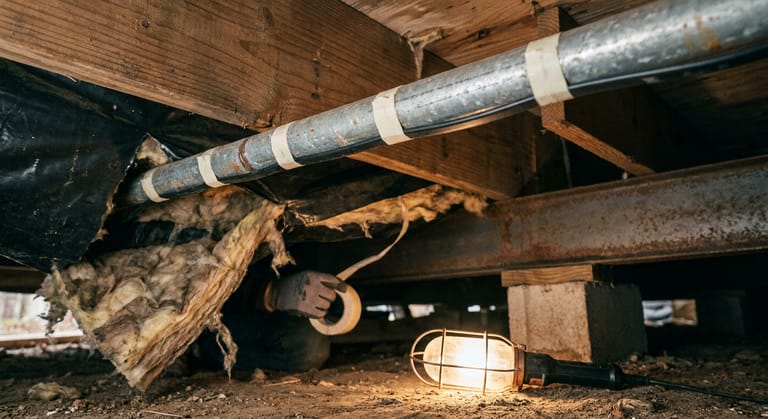
Heat tape for mobile home pipes: what the cable may touch
Frost King's own FAQ asks whether its Heat Cable Kits can go on mobile home feed lines and answers no: too flexible, walls too thin for the temperature the cable works at, garden hose being the comparison. One maker on one line type is not a ruling on every cable; Chemelex sizes its self regulating product for plastic pipe too.
Even inside one brand the permission is narrow. Frost King allows its kits on plastic only where the pipe is a supply line of 3/8 in to 1 1/2 in outside diameter with Schedule 40 printed on it, and answers no to PVC. The sheet also says the cable must not be buried or touch the ground, which matters where a supply run sags over bare earth.
CPSC's wording is broader: codes admit many pipe materials, so the material under your home picks the tape, its diameter and length known first.
Where heat tape and pipes run under a mobile home
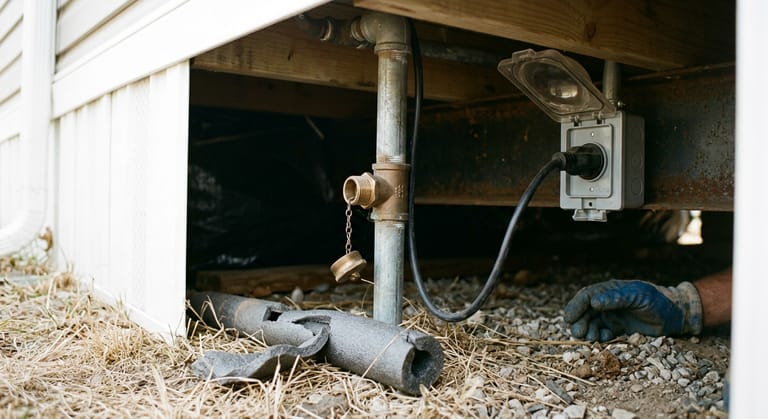
Under mobile homes and in crawl spaces is where this cable ends up, per CPSC's 1990 description: wherever water and drain pipes hang exposed to winter. Here that is the belly cavity, the crossover under a double wide, and the bare stretch at the riser.
Federal rules treat freeze protection as built in equipment. The construction side, 24 CFR 3280.603(b)(4), gives the builder two duties: insulate or protect piping and fixtures that could freeze in normal occupancy, and state in writing that any cable used is listed or certified for its purpose. On site, 24 CFR 3285.603(d)(2) reaches exposed supply piping, shutoff valves, pressure reducers and pipes in water heater compartments, (d)(3) narrowing it to listed and certified cable fitted to its maker's instructions.
How to install heat tape under mobile home floors
- Kill the power first. Unplug the old cable and leave it unplugged while anyone is under the floor. A panel, a 240 volt circuit or a gas appliance in that compartment is licensed work, and gas gets shut off at the appliance valve first.
- Read the sheet in the box. Requirements move between types and brands, so CPSC sends owners back to the instructions at every switch. The box in your hand governs.
- Count runs, do not spiral. Frostex is designed to lie straight down the pipe, not wind around it, and Chemelex counts whole runs, one per pipe length, adding a second or third in parallel as the cold deepens. Its ceiling is 50 ft per circuit on a plug kit fused at 10 A, which a long belly run passes quickly.
- Fasten with the tape the maker names. Frost King calls for its own application tape or electrical tape rated to at least 176 F; Chemelex rules out vinyl electrical tape entirely, and metal straps or tie wire. They disagree, so follow your sheet.
- Cable against the pipe, fiberglass over the top. The order is not negotiable at CPSC: cable on bare pipe, insulation afterwards over both. Reach for fiberglass, since foam and vinyl can be set alight by a failing cable, and stay under the maker's limit, since too much insulation is itself a fire cause. Frost King specifies 1/2 inch with a vapor seal.
- Finish dry and grounded. Water inside the end cap can lead to a fire, so seal it and keep the end off the ground. The three prong plug goes into a grounded receptacle with GFCI protection behind it.
Talk it through with a mobile home plumber
Call (800) 555-0176Free to dial. You reach a licensed plumber who works on manufactured homes.Partner plumbers who service manufactured homes- Plumbers who actually work on manufactured homes
- Line answered day and night, all year
- Dialing costs you nothing
- Price talk happens between you and the plumber
How to check heat tape on mobile home pipes each fall
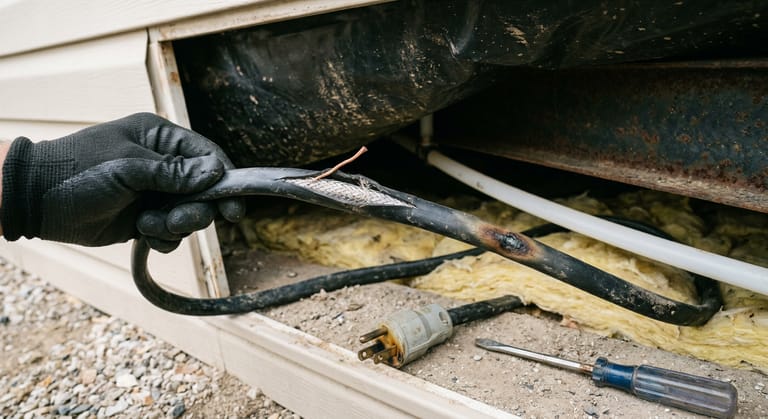
Once a year is the frequency CPSC sets, naming the deterioration that ends a cable's service: discolored surfaces, worst at the plug; charring; a jacket cut or broken; bare wire. Those four are the checklist, and the plug is the part an owner can usually reach without opening anything.
Its verbs escalate. Cracked or damaged covering was grounds for replacement in the 1989 release; bare wire or charring marks moved it from should to must, a new cable going in. Damaged thermal insulation means a careful look at the jacket underneath.
Two findings from those investigations still hold: many homes went uninspected, and some residents had no idea a cable was there. If you bought the place used, start by finding out.
How long it lasts, and when replacement is the honest answer
The three year rule people repeat is narrower than they think. What CPSC urges is that uncertified heat tape past 3 years of age come out, replaced by cable certified against the voluntary standards UL, CSA and FMRC set, the newer product having much the better record. The trigger is the word uncertified, not the calendar on every installation.
For certified cable no service life figure appears in the federal record. The documented duty is the yearly look above, plus a repair rule: Chemelex tells installers not to repair or energize damaged cable but to remove it and fit a new length.
Six years of data sat behind the October 1990 release, where CPSC put mobile homes and trailers at over half of heat tape fires. Its totals do not line up, so no honest page quotes one alone: that release estimated about 3,300 residential fires a year with 20 deaths and 160 injuries, the January 1996 release about 1,500 fires and 10 deaths from faulty electric heat tape. Both are decades old. If nothing on the cable identifies it, replacing beats guessing at its age.
What heat tape costs to install and to run
No federal source or trade dataset publishes a national installed price for heat tape for a mobile home, so any per foot average is guesswork. Cable price, run length, the number of runs and whether the belly must be opened all move it.
Finding mobile home heat tape installers near me
Four questions sort the specialists from the handymen. Does the cable hold a listing and certification for its intended purpose, as 24 CFR 3285.603(d)(3) demands? Will the built in receptacle within 2 feet of the cold water inlet be used, not a cord? Will insulation go back over the pipe, not between the pipe and the floor above? And will the sheet be left with you, since requirements move between brands? Anyone who works on manufactured homes answers all four without pausing.
When to stop reading and dial
- The jacket shows charring, cuts or bare wire, or the plug is discolored.
- The outlet under the floor is two prong, ungrounded or dead.
- Nobody can identify the line the cable would sit on.
- The belly is torn or wet, so repairing the underbelly comes before any cable.
- Water has already stopped, which is the frozen pipe sequence, not this one.
Any of those, call (800) 555-0176. Ringing it costs nothing, someone picks up day and night, and the licensed plumber who answers fits and checks heat tape on manufactured homes as routine October work. Haverlane writes and turns no wrenches; a booked job can send a referral fee back here, never added to your price. The rest of the season sits in the winter prep sequence.