The Water Heater That Fits a Mobile Home Closet
The short version
- HUD at 24 CFR 3280.709(d) bars a combustion system open to the interior, so a gas tank here is either sealed combustion or shut inside a closet with no opening indoors.
- A. O. Smith's manual publishes 0 inch side and back clearances for these closets, which is why tank diameters of 18, 20 and 22 inches at 30, 40 and 50 gallons decide everything.
- Nominal is marketing: A. O. Smith's EMHL-30 is a 28 gallon body that stores 26, sold under 30 gallon shelf names, and 30 gallon gas tanks are rated at 29.
- HomeGuide 2026 puts installed replacement at $500-$1,900 for 30 gallons and $700-$3,100 for 50, plus $125-$300 on each labor hour eaten by a cramped closet.
- Reliance, State and A. O. Smith are one corporate family and Richmond is a Rheem brand, so four spec sheets agreeing is really two companies talking.
A mobile home water heater is its own listed appliance, not a regular tank with a different sticker. HUD's rule at 24 CFR 3280.709(d) will not allow a combustion system open to the interior, and the tanks come 18 inches across at 30 gallons, 20 at 40 and 22 at 50 (A. O. Smith).
Everything below follows from those two facts. Haverlane writes about this trade and does none of it; the phone number routes to a partner plumber, licensed, who spends real weeks under manufactured homes. A booked job from that call can pay Haverlane a referral fee, funded on the plumber's side and absent from every line of your estimate.
Why a hot water heater in a mobile home is a different box
Fuel burning appliances must be installed "to provide for the complete separation of the combustion system from the interior atmosphere," and HUD allows two ways to get there: a direct vent sealed combustion appliance, or an enclosure with no door, panel or opening into the home (24 CFR 3280.709(d)). Option two is where the little steel door on your exterior wall comes from.
The manufactured housing manual from A. O. Smith says the same in its own words: "FOR USE ONLY IN MANUFACTURED HOMES," no draft diverter, and combustion air pulled from outdoors through a 3 inch intake duct at 30 and 40 gallons, 4 inch at 50. A side by side against a residential tank covers the rest.
Three sections worth knowing. 3280.609(a)(2) makes a listed water heater mandatory wherever the home has a kitchen sink plus a bathtub or a shower. 3280.709(d) is the sealed combustion paragraph above. 3280.707(a) now asks that heat producing appliances and vents be "listed or certified for residential use," reworded at 89 FR 75754 effective September 15, 2025, where it once said listed for use in manufactured homes. That rewrite left 3280.709(d) alone.
Read your rating plate yourself. Choosing the replacement, and every inch of gas and vent work behind it, is a licensed plumber's call.
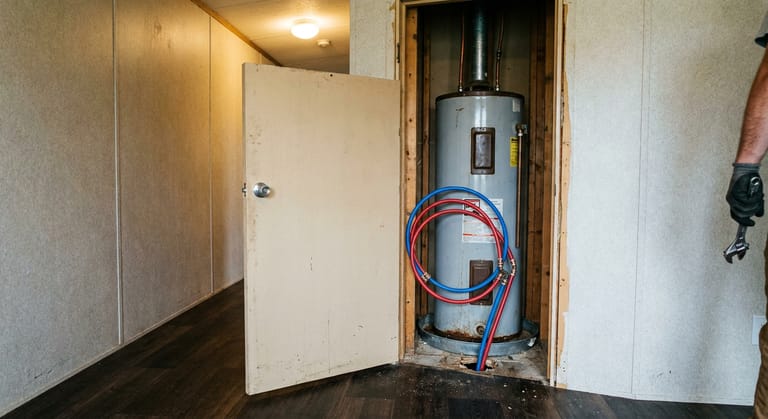
The closet decides the size before you do
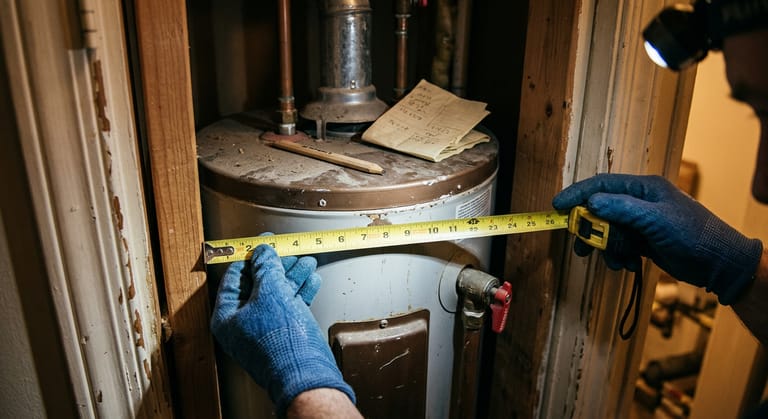
A. O. Smith's manual puts minimum clearances at 0 inches to the sides, 0 at the back, 4 inches from the jacket front to the door, 27 inches above the jacket and 24 inches of front space for service. Zero at the sides means the closet was framed to the tank, so an inch of extra diameter does not go in.
| Nominal | Actually stores | Diameter | Fuel in this class |
|---|---|---|---|
| 28 gal lowboy | 26 gal | 22 in., 30 in. tall | Electric, sold under 30 gallon names (EMHL-30) |
| 30 gal | 29 gal on gas | 18 in. gas, 19 in. electric | Gas 30,000 BTU direct vent, 35,500 atmospheric |
| 40 gal | 38 gas, 36 electric | 20 in. gas, 22 in. electric | Both, widest choice |
| 50 gal | 47 gal | 22 in. | Gas only, no listed electric 50 |
Capacities and diameters from the Reliance 2026 spec sheet and A. O. Smith's ProLine pages.
Two consequences. Going 30 to 50 is a rebuild, not a swap: four more inches of diameter and a 4 inch combustion air duct instead of 3. And 28 gallons measured where the carton says 30 is not a swindle, it is the published figure.
Electric, gas, and what the efficiency label hides
Electric units in this class run UEF 0.90 to 0.95, gas storage models 0.57 to 0.61, on the makers' own spec pages. That gap is thermal efficiency, not your bill, and local power and propane prices decide the bill. The vent type below matters more, and those figures come off Reliance, Richmond and ProLine pages.
Direct vent
- Sealed combustion, all air from outdoors
- Suits an interior compartment
- Roof jack kit ordered separately, sized to vent length
- Reliance certifies to 5,400 ft, Richmond states 10,000
Atmospheric
- 35,500 BTU at both 30 and 40 gallons
- First hour rating 63 gallons at 30, oddly beating the 59 at 40
- Flammable vapor detection on Rheem and Richmond versions
- Rheem certifies its 40 gallon to 8,400 ft, its 29 gallon to 6,000
Gas models here ship for natural gas with a propane burner in the carton, and propane inputs land slightly lower, 29,000 BTU where natural gas gives 30,000. Detail pages: gas units and electric units.
Elements, voltage, and why the hot water disappears
State sells a 40 gallon electric tank at 120 volts, 3,000 watts, two elements, first hour rating 40 gallons against 54 on the 240 volt twin. Reliance lists single element units at 1,500 watts. Richmond states the trade plainly: recovery is 17 gallons per hour at 3,500 watts and 21 at 4,500, at a 90 degree rise. Chasing capacity? Read the 40 gallon electric numbers first.
Before anything is opened. Kill the breaker to the tank and confirm it is dead. A 240 volt element circuit, a new dedicated circuit or any gas connection is licensed work, not a Saturday job. Reliance's unusual 3,800 watt elements are a real trap: drop a generic 4,500 watt element into that circuit and you have quietly overloaded it.
Reliance mobile home water heater models on the shelf
The Reliance 6-Year Mobile Home line runs atmospheric vent (6-30-NOMT, 6-40-NOMT), direct vent (6-30-MDV, 6-40-MDV) and an electric list from the 1,500 watt 6-30-SHLK to the 4,500 watt 6-40-EMHSDH. Its 2026 spec sheet is the cleanest table in the niche: every model meeting HUD requirements, side inlet and top outlet water connections, standard vent good to 10,100 feet, direct vent to 5,400.
Warranty across the segment is 6 years on tank and parts, Reliance adding a year of labor. One caution: Reliance, State and A. O. Smith are one corporate family, so three matching spec sheets are one company agreeing with itself.
Talk it through with a mobile home plumber
Call (800) 555-0176Free to dial. You reach a licensed plumber who works on manufactured homes.Partner plumbers who service manufactured homes- Plumbers who actually work on manufactured homes
- Line answered day and night, all year
- Dialing costs you nothing
- Price talk happens between you and the plumber
Richmond mobile home water heater and the co-axial exception
Richmond, a Rheem brand, fields four manufactured housing products under its Essential name: standard electric, direct vent, direct vent co-axial and atmospheric, all bulleted "certified for manufactured (HUD) and modular construction."
The co-axial one matters beyond Richmond. It lists 3/4 inch hot and cold water connections on top, a smaller footprint with no external air tube, and is marketed as fitting a standard drain pan, which HUD requires under every storage tank here (3280.709(h)). The field rule that these tanks always take water in the side is a tendency, not a law.
Where the tank hides and what to write down
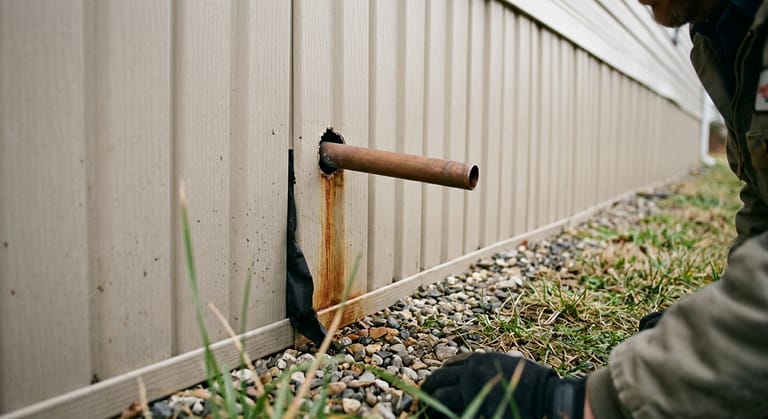
Half of these calls start with nobody able to find the thing. HUD's interior finish rule names combustible doors "which provide interior or exterior access to furnace and/or water heater spaces," so an outside hatch is normal here, and carpeting is banned in a compartment built only for a furnace or a tank (3280.205). The walkthrough on locating it covers the hallway closet, the exterior hatch and the utility room.
- Photograph the rating plate. Model number, gallons, fuel, voltage and wattage or BTU input all sit there.
- Measure tank diameter and the door opening. Two inches decides whether an upsize is possible.
- Note the vent. Sealed pipe through the roof, or an atmospheric flue.
- Follow the relief valve discharge. HUD requires it piped to the exterior, "not underneath the home," ending 6 to 24 inches above grade, untrapped and visible. A line dumping into the belly is a violation and a rot problem.
With those four answers a plumber prices the job on the phone. Installation walks the rest, and a HUD listing check settles whether a model qualifies.
Tankless and heat pumps, and what nobody builds
Across A. O. Smith, State, Reliance, Rheem and Richmond there is no tankless and no heat pump water heater listed specifically for manufactured homes, and no HUD listed 50 gallon electric either. A conversion is not impossible, it is an engineering job: venting, gas capacity and electrical load all change. HomeGuide puts tank to tankless labor alone at $600-$2,500, half a day to a full day, before parts. The tankless page works through when that math survives contact with this housing.
What a replacement costs in 2026
National ranges from HomeGuide, never a quote. Installed: $500-$1,900 at 30 gallons, $600-$3,000 at 40, $700-$3,100 at 50. Labor alone runs $200-$1,000 on a same size swap, 2 to 6 hours. Then the adders this housing attracts: $125-$300 on each labor hour lost to cramped access such as a closet, $100-$600 for replacement venting or $500-$1,500 first time, $50-$200 in permits, $250-$900 for a dedicated circuit, $75-$500 for disposal. Repairs average $455 across 349 reported projects, in a $150-$700 band.
That cramped access surcharge is not a footnote here. It describes precisely the compartment these tanks live in. Short of the 10 year mark HomeGuide flags, price a repair first.
Five findings that mean stop and dial
Any one of these ends the reading. Gas smell near the compartment, soot around the vent, water standing in the drip pan, a relief valve that dribbles, or a tank past a decade that has begun to knock.
Call (800) 555-0176. Dialing costs nothing and a licensed plumber who works on manufactured homes picks up, day or night. Bring the four notes above and the conversation starts at the price, not the guesswork.