Mobile Home Underbelly Repair
The short version
- Joist direction names the belly type: crosswise joists sit above fabric, lengthwise joists above rigid asphalt-impregnated board, per South Carolina's weatherization field guide.
- The federal material spec is a number, not a plastic. Bottom board must hold 48 inch-pounds in the Beach Puncture Test, and patch life must equal material life (24 CFR 3280.305(g)(6)).
- HUD treats closing the belly as plumbing work: insulation back before closure, splits resealed the manufacturer's way, floor traps checked, every edge of the repair sealed (3285.804).
- Fabric seams carry the job. Lap 6 inches, run a continuous bead of sealant, fasten every 2 inches, and wrap rigid supports twice.
- Insulation placed between a supply line and the warm floor is what freezes it, so field crews run belly paper under the pipes instead.
Most mobile home underbelly repair is patching, not replacement. On a rigid belly the weatherization field guide draws the line at 1 square foot: smaller holes take a fastened patch, larger ones get cut back to a rectangle bordered by joists.
The sheet under the floor of a manufactured home is what federal rules call the bottom board, and it is not skin. Water lines, drains and floor traps live in the cavity it closes, which is why HUD's close-up rule pairs bottom board work with a plumbing check in the same four paragraphs.
Soft belly or hard belly, and how to tell in a minute
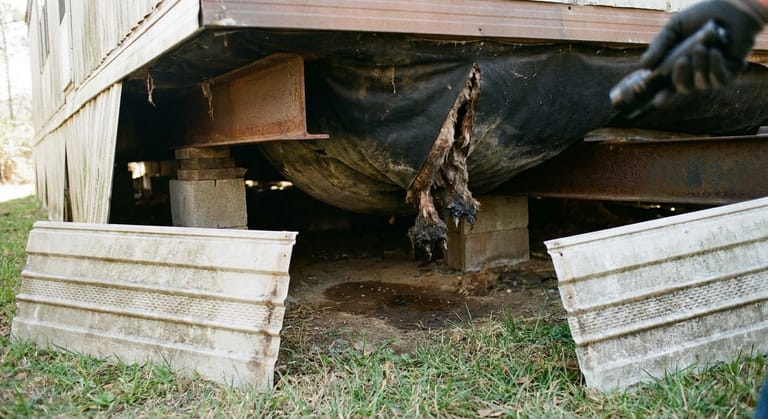
Look at the joists. The 2021 South Carolina Weatherization Field Guide sorts mobile home floors into two families; the family decides the repair. Crosswise joists carry a woven sheet that sheds water, resists tearing and forms the cavity's air barrier. Lengthwise joists carry a rigid board instead, water resistant, usually asphalt-soaked fiberboard.
It also explains the sag owners point at from the yard. The crossover duct on a soft belly runs lengthwise, sags and drags the sheet below into a low spot. Water pools there.
| Tell | Fabric belly | Rigid belly |
|---|---|---|
| Floor joists run | Crosswise | Lengthwise |
| Material overhead | Tear-resistant woven sheet | Asphalt-impregnated fiberboard |
| Typical failure | Sagging bulge, split seam, rodent hole | Wet board crumbling at the fasteners |
| Repair method | Span, lap and fasten a new sheet | Cut a square patch into the joists |
Settle the type before buying: fabric does nothing for crumbling fiberboard, and a wrong guess costs a second trip under the home.
What the code asks of a patch
The federal standard is short here. Three duties share one paragraph, 24 CFR 3280.305 at (g)(6). First a number the board must clear, patched or not: 48 inch-pounds of puncture resistance, Beach Puncture Test. Then patchability, with the code fixing how long a patch lives: "the patch life must be equivalent to the material life". Last, fit: the board sits tight against every penetration.
Penetrations there are the holes your plumbing drops through, and a board fitted loose around a drain stub is a code miss and a cold air path.
How to repair mobile home underbelly, step by step
- Open back to sound material. Pull the sheet or soft board back until edges are dry and firm. Fiberboard wants one pass more: scrape the patch zone down, since anything left there keeps sealant and patch from bonding.
- Find why it got wet. Soaked insulation over a dry board means a leak above; a wet board under dry batts means groundwater or an open seam. Plumbing gets repaired first, then the belly.
- Bag the ruined insulation. Wet fiberglass never recovers loft, so it leaves the home instead of going back over the pipes.
- Put insulation back before closure. HUD writes the order into its close-up rule: missing insulation goes back in first, board closed and repaired after. That is a sequence, not a preference.
- Close the sheet the way the material wants. Fabric and fiberboard take different hands, both covered below.
- Seal every edge, then check the traps. Two duties close that HUD section. Every floor P-trap gets checked and must leave the job insulated and covered. Every edge you cut or lapped gets tape or an equivalent seal.
Steps one to three are honest owner work on a dry day. A wet cavity, a gas line or a sagging drain run is the point to hand the light to a partner plumber, on a free line at (800) 555-0176.
Mobile home underbelly repair tape and what it has to do
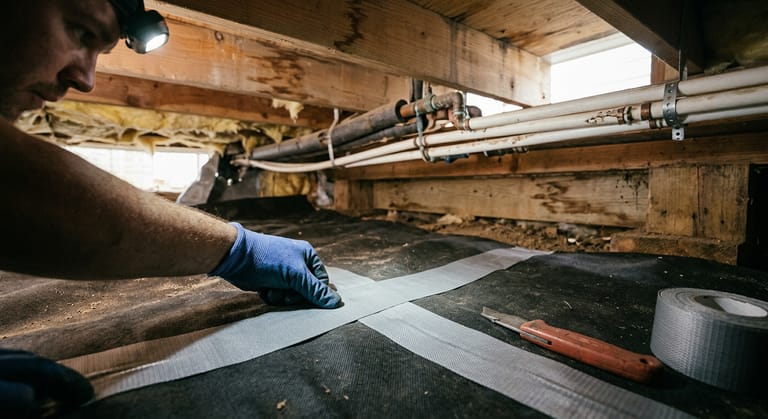
Tape is written into the rules, not merely tolerated. A split or tear in the bottom board has two sanctioned answers under 24 CFR 3285.804, tape or a patch, on one condition: the method the home's manufacturer publishes in its installation instructions.
The catch is that life clause. Tape has to be a belly product with the adhesive and width for the job, on a surface wiped clean and dry. Fabric sheeting also takes stitch staples in the field, not adhesive alone.
Mobile home underbelly repair kit, item by item
Shop by belly type. Fabric and fiberboard share a list only in the sealant aisle.
| Item | Why it is on the list |
|---|---|
| Matching sheet material | Field practice answers each belly in kind, water resistive material for water resistive |
| Belly tape rated for that material | Splits, seams and every edge of the repair (3285.804(b) and (d)) |
| Fasteners with washers or caps | Heads pull straight through rigid board without them |
| Unfaced fiberglass and pipe wrap | Insulation goes back before closure, hot lines at R-3 minimum |
The field guide's numbers for a fabric repair are worth writing down. One uninterrupted piece per belly section, seams lapped 6 inches minimum, a continuous sealant bead in the lap, mechanical fasteners at 2 inch spacing, two full wraps around any rigid support fastened every 6 inches. Rigid board answers to other rules: like material fastened into the joists, a hole past 1 square foot cut back to a joist-bordered rectangle for a close-fitting panel.
Talk it through with a mobile home plumber
Call (800) 555-0176Free to dial. You reach a licensed plumber who works on manufactured homes.Partner plumbers who service manufactured homes- Plumbers who actually work on manufactured homes
- Line answered day and night, all year
- Dialing costs you nothing
- Price talk happens between you and the plumber
Insulation, R-values and the pipes you are burying
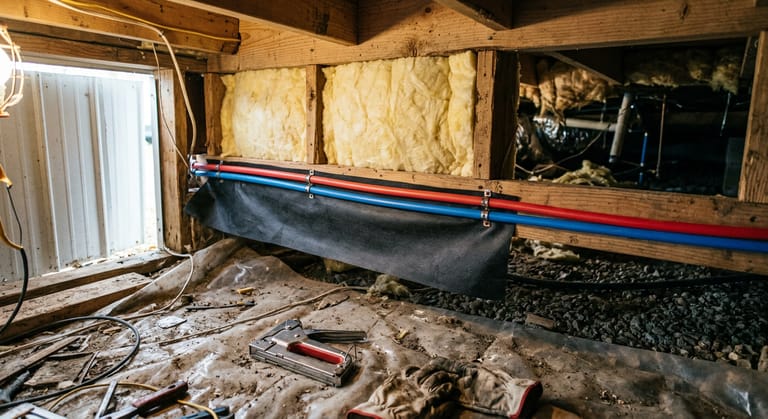
That same guide would rather see blown fiberglass here than cellulose, and whatever goes up must hold 25/450 or better on flame spread and smoke development. Where a bay lost sheet and fill together, unfaced batts are the accepted partial repair.
Placement decides whether the work survives January. Locate every supply line before a batt goes up: fill stacked between that pipe and the warm floor shuts it out of the only heat it has. The answer is belly paper slung under the run with the pocket over it filled, leaving the line on the warm side. Get it backwards and you have built what freezes under a manufactured home.
| DOE floor insulation minimum | Zone 1 | Zone 2 | Zone 3 |
|---|---|---|---|
| Tier 1, single section home | R-22 | R-19 | R-22 |
| Tier 2, multi-section home | R-13 | R-19 | R-30 |
Those are the Department of Energy floor numbers in 10 CFR 460.102, tables 1 and 2. Read them as a target, not a promise about your own home: the compliance date still waits on enforcement procedures DOE has not finalised. HUD instead caps whole-envelope Uo value by zone, which is why older data plates carry no floor R-value. Hot water piping in this cavity wants R-3 wrap under 10 CFR 460.203(d).
Straps, traps and heat tape while the cavity is open
An open belly is the cheap chance to repair what tore it, and support comes first. Field guide crews check every gas, water and electrical run is tied to framing at 4 feet or tighter. Plastic is on a shorter leash in the construction standard: 3280.608(b) allows 4 feet between supports on horizontal drainage, 3 feet on water piping, on hangers that neither crush nor chafe.
The factory insulates floor P-traps, so whatever you strip off to reach one goes back on, per HUD's installation guidance. Rodents get their own line: openings around piping are sealed to keep them out (3280.603(b)(6)).
How to install plumbing under a mobile home without wrecking the belly
Washington State's Department of Labor and Industries keeps a pre-inspection checklist for repiping a manufactured home, and it travels well. Its inspector wants pipe sized to 3280.609(f) and run the manufacturer's way, no shared floor hole for piping and wiring, foam closing every penetration, freeze protection throughout, crossovers with proper fittings.
Its belly items are why this sits on a repair page. A bored joist keeps 2 inches clear top and bottom, the hole no wider than a third of the joist depth, insulation returns at its old R-value, the board patched to equivalent life.
New runs and repipes are licensed territory in most places, and broader plumbing repair under a manufactured home starts here too.
The ground sheet is a different layer
Two sheets get confused. The bottom board hangs on the joists; the ground moisture barrier lies on the dirt. Once skirting encloses the crawl space, 3285.204 wants the soil covered in 6 mil polyethylene or equivalent, 12 inches of overlap where pieces meet, voids and tears repaired.
Skirting is the third layer, and 3285.504 sets a yardstick its panels must at least match: zinc on steel at 0.30 oz per square foot. Panels off their track wind-wash the cavity you closed.
What a belly repair costs, and where owners stop
No federal dataset or verified survey publishes a price for this job, so a single confident figure is invented. What moves the repair bill is visible from the ground: how many bays open, fabric or board, how wet the insulation is, whether a line split. Tape on a dry split is an afternoon. A belly full of water over a leaking crossover, or anything near a gas line, is another job.
Dialing (800) 555-0176 is free, and it is answered by a licensed plumber who spends the week under manufactured homes, day or night. Describe the sag, hear what mobile home underbelly repair takes on your floor, and settle the price in writing before a fastener goes in.
Talk it through with a mobile home plumber
Call (800) 555-0176Free to dial. You reach a licensed plumber who works on manufactured homes.Partner plumbers who service manufactured homes- Plumbers who actually work on manufactured homes
- Line answered day and night, all year
- Dialing costs you nothing
- Price talk happens between you and the plumber