How to Winterize Your Mobile Home Before the Cold Sets In
The short version
- The job is under the floor. HUD pairs bottom board repair with a plumbing check in 24 CFR 3285.804: once splits and tears are resealed, P-traps must be checked to be sure they are well insulated and covered.
- Close the vents, never seal them. HUD requires adjustable vent covers in freezing areas (24 CFR 3285.505(d)) while requiring dryer vents and combustion air inlets to pass through the skirting to outside air (3285.505(f)).
- Insulation belongs over the pipe, never between the pipe and the floor above it. The South Carolina Weatherization Field Guide runs belly paper beneath the line and fills the pocket that makes.
- Heat cable gets looked at, not assumed. CPSC names four warning signs on a tape: a discolored plug, scorching, a damaged jacket and exposed wire.
- An empty home needs draining, not a low thermostat. NWS says leave the heat at 55 degrees or above when you travel; Purdue Extension drains a hot water heating system once the room drops below 40.
Most of the work to winterize a mobile home happens under the floor: skirting vents closed, belly tears patched, the riser shutoff located, heat cable checked before the first 32 degree night. Freeze Warnings out of the National Weather Service office in State College, Pennsylvania start at a zone low of 32 degrees or below. Order matters more than effort: a pipe on the cold side of the insulation freezes anyway.
Why the belly decides your winter
Supply lines, drains and floor traps sit in the cavity closed by the bottom board, HUD's name for the belly wrap. Patching and insulating are one job at HUD, written into 24 CFR 3285.804: reseal every split and tear, then check the P-traps and confirm each is still insulated and covered. The South Carolina Weatherization Field Guide ranks a split belly wrap with the most serious envelope leaks in mobile homes: the tear hands that cavity to a vented crawl space.
Two runs give out first in partner plumbers' callouts: the crossover joining the halves of a double wide, and the riser at the main valve, which HUD puts under or beside the home.
Placement is what owners get backwards. The field guide never lets batt sit between a water line and the floor above it: belly paper goes beneath the run, the pocket above it is filled, and the pipe ends up in warm air. Taping a small tear is owner work; a wet, sagging wrap needs proper underbelly repair first.
Skirting vents get closed, not sealed
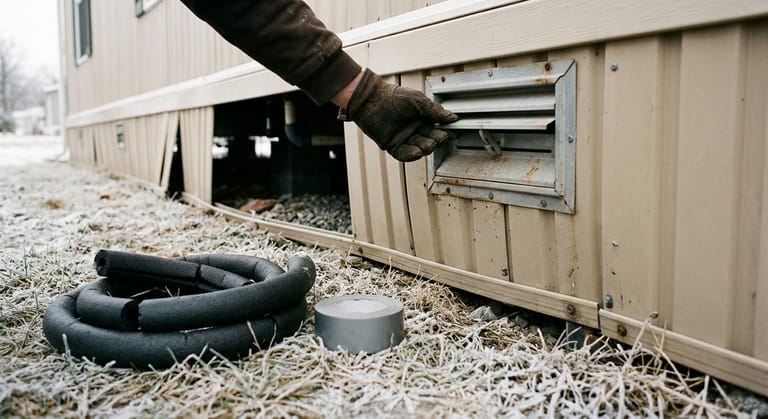
HUD settles the October argument. Anywhere that freezes, the covering over a skirting vent has to be the adjustable kind under 24 CFR 3285.505(d), worked open or shut as conditions ask. Closeable is the design. Sealed is not.
How much venting your mobile home carries is arithmetic: one square foot of net vent area per 150 square feet of floor, or one per 1,500 with 6 mil polyethylene over the ground. A 14 by 70 single section is 980 square feet, so about 6.5 square feet of vent.
Look at the heat cable before you trust it
Cable that worked last March is not evidence. Once a year is the CPSC interval for heat tape, and any sign of deterioration retires it: a plug gone brown, scorch marks, a jacket cut or split, copper showing. Most consumers, the agency says, should hand it to an electrician.
Three rules decide whether cable helps or starts something. It rides against the pipe wall, with insulation over the top of it, never underneath. That covering is non-combustible, fiberglass and not foam or vinyl, no thicker than the maker permits. And it has to suit the pipe: asked about mobile home feed lines, Frost King turns down its own heat cable kits, because the line bends too easily and its wall is too thin. Read the sheet in your box.
The 3 year figure gets quoted too broadly: CPSC aims it at uncertified tape, not at listed cable. Sizing sits on the heat tape page.
Your mobile home winterization checklist for one afternoon
- Walk the skirting. Reseat panels off their track, set vent covers for the forecast.
- Open the access panel. Torn wrap, hanging batt, standing water, daylight at a corner.
- Trace the crossover. On a double wide, confirm the line between sections is insulated and strapped.
- Turn the main valve. A stiff riser valve in October is a broken one in January.
- Inspect cable and plug. The four CPSC signs, plus proof the plug sits in the under-floor outlet.
- Insulate what runs cold. Exposed supply, valves and heater lines, over the pipe, strapped within 4 feet per the field guide.
- Set the thermostat. NWS says 55 degrees minimum if you travel, sink cabinets open on hard nights.
Winterize the underside once in the fall and most winter callouts never happen. Two findings end the afternoon early and mean a call: standing water under the floor, or cable showing any of the four signs.
Talk it through with a mobile home plumber
Call (800) 555-0176Free to dial. You reach a licensed plumber who works on manufactured homes.Partner plumbers who service manufactured homes- Plumbers who actually work on manufactured homes
- Line answered day and night, all year
- Dialing costs you nothing
- Price talk happens between you and the plumber
What it costs to winterize a mobile home
No one publishes a national price for mobile home winterization, so a quoted figure is a guess. What moves it sits in your own crawl space: how much bottom board hangs open, whether insulation is replaced or just pushed back, cable length and runs, drained or only tightened.
How to winterize a mobile home that is vacant
Empty changes the job on mobile homes. Purdue Extension gives the order for a house losing heat: main valve off first, pressure tank drained, every faucet left open until it stops running, unions near that valve broken, insulation over whatever will not drain, toilet tanks emptied, softener disconnected.
Appliances come next. Maine CDC's list: water heaters, power off before the tank drains, plus dishwashers, toilets and ice maker lines. Purdue adds closing the furnace and dryer valves.
| Situation | Water | Heat | Traps |
|---|---|---|---|
| Away for a week | On, valve located | 55 F or above (NWS) | Nothing needed |
| Vacant or seasonal | Off at the riser, drained | Off once the lines are drained | Dosed, 1 pint to 1 quart |
Traps are the exception: the water sealing them is displaced, not removed. Purdue's dose is propylene glycol antifreeze equal to the water in the trap, 1 pint to 1 quart by size, at sinks, tubs, toilets, showers and floor drains. Maine CDC gives the reason: it stops bowls cracking and keeps sewer gases out. Never automotive antifreeze.
Taps, toilets and traps are an afternoon of owner work. The heater and the main valve are not: read how the shutoff valve works on these homes, and hand a gas heater to a plumber.
Blowing out mobile home water lines
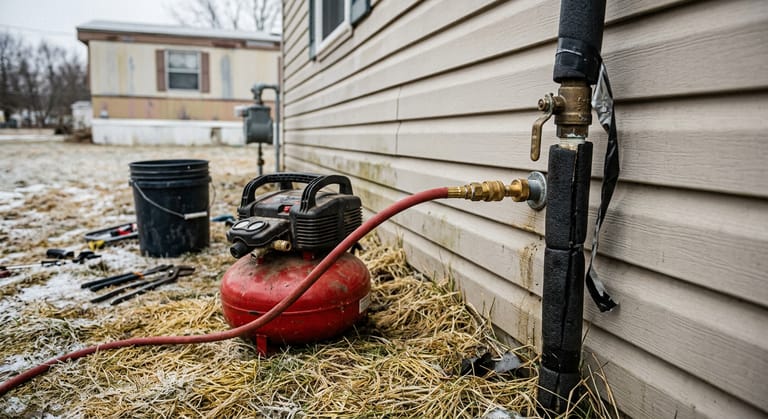
Compressed air is accepted practice, not a shortcut: Purdue Extension lists it among the ways to clear water out of the pipes. Minnesota's health department adds the one equipment rule any agency states outright, an oil-less compressor: an oiled one puts oil mist into drinking water.
The physics come from Maine CDC. If the run already falls toward a low point, gravity may do it once the top outlet is opened and then the bottom one. Otherwise air enters at the top and pushes the water out at the bottom. Cap every opening, close every valve once dry.
HUD requires the piping to be arranged so it can drain, which is why this works in mobile homes at all. A sagging run defeats it, and that is a plumber's crawl.
Park models, trailers and older single sections
Age sets the workload. Census Bureau ACS 2024 estimates put roughly 23 percent of occupied units in this category, labelled mobile home, boat, RV or van, as built before 1980. An older trailer means patched wrap, slumped batt and unstrapped runs. A park model or seasonal mobile home gets the vacant treatment on the calendar, not the thermostat: nobody is there to notice a dripping tap.
When to stop reading and call
- Water is running under the floor, or the wrap is wet and sagging.
- The main valve will not turn, or nobody can find the riser.
- Heat cable shows a discolored plug, charring, cuts or bare wire.
- The work sits beside a gas water heater, its vent or wiring.
- Taps are already dry, which is the frozen pipe sequence, not this one.
Any of those, the number is (800) 555-0176. The call is free, the line is staffed around the clock, and whoever answers works on manufactured housing, so mobile home winterization services are an ordinary October booking. Haverlane publishes and does no plumbing; if a call becomes a job the partner may pay us a finder's fee, and your price does not move.