Low Water Pressure in a Mobile Home, Cause by Cause
The short version
- HUD makes the manufacturer state that the home was designed for an inlet of 80 psi, so that is the number your hose bib gauge gets compared against.
- Weak at one tap is a fixture problem. Weak everywhere is the riser, the belly or the supply itself.
- The federal sizing table allows tubing as small as 3/8 inch outside diameter on a branch feeding one fixture, capped at six feet.
- Aerators, angle stops and the main valve are homeowner ground. Crushed lines under the floor and anything at the heater are not.
Low water pressure in a mobile home is usually a restriction, not a shortage: HUD designs these homes around an 80 psi inlet, and something downstream is eating it. Two questions sort it fast. Is every tap weak, or one? Is the cold side weak, or the hot?
Answer both before buying a part.
Measure first, take things apart second
Collect static water pressure at an outside hose bib first. HUD sets the yardstick in 24 CFR 3280.609(a)(1). The manufacturer's written instructions carry two things: 80 psi as the inlet the home was designed around, and a reducing valve wherever supply sits above it. Park mains and private wells land on both sides of that line.
Then read the pattern at the taps.
| What you notice | Where the water pressure usually goes |
|---|---|
| Every tap weak, hot and cold alike | Supply side: riser valve, inlet, reducing valve, main branch |
| One fixture weak, the rest fine | That aerator, that cartridge, that angle stop |
| Hot weak, cold strong | The heater's cold feed valve or its side connection |
| Cold weak, hot strong | Upstream of the tee that feeds the water heater |
| Only in freezing weather | Partial ice, usually the riser or a crossover |
| Since the last repair | A kinked or half closed line left behind |
That two minute read saves an afternoon of swapping parts on a hunch. If the table sends you under the floor and crawling is not in your week, hand it over there.
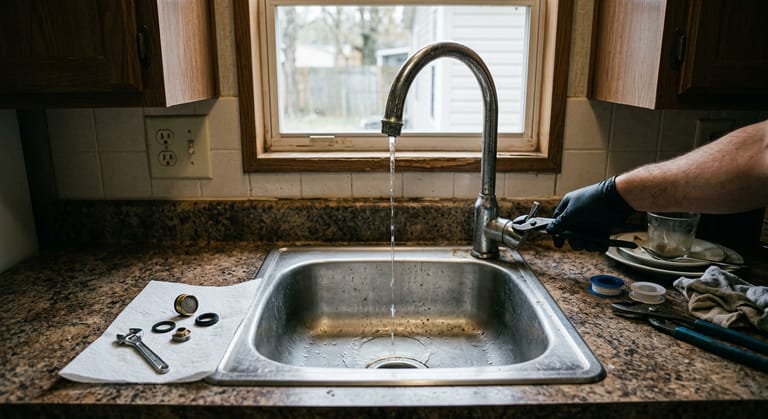
Mobile home low water pressure: the six usual causes
These six cover nearly everything the field sees, in rough order of effort.
- Scaled aerators and shower heads. The reason one fixture reads weak while the tap next to it is fine.
- Stops and the main valve. An angle stop half turned, or a tired main valve at the riser that no longer opens fully.
- Branches narrow from the factory. The federal table permits smaller water tubing here than a site built house uses.
- A crushed or kinked run in the belly. Staples, sags and rodents pinch a plastic line without breaking it.
- Ice. A plug still forming reads as a thin stream, not as a dead tap.
- The water supply itself. A park main under load, a well pump losing its stride, or a reducing valve trimming pressure harder than it should.
Most homes give up the answer by item four. Past that you are into pipe, where a free call to a plumber who knows this housing type saves a wasted Saturday.
Low cold water pressure in a mobile home, and what it rules out
Cold weak while hot runs strong is unusual and useful: it puts the fault upstream of the tee feeding the water heater, at the inlet, the riser valve, a reducing valve or a partly frozen run.
The reverse points at the heater rather than the pipe. Tanks built for this housing type are plumbed differently. A. O. Smith's manufactured housing direct vent gas spec sheet puts the 3/4 inch cold inlet on the side and the hot outlet on top, because supply here climbs from under the floor, not down from a ceiling. That side connection carries a valve nobody has moved in a decade, which makes it a fair suspect.
Kill the energy before hands go near the heater. Switch its circuit off at the breaker, or close the gas valve at the appliance, before touching a fitting. Anything sealed, vented or wired at 240 volts on that appliance belongs to a licensed pro rather than to a Saturday.
Testing that valve is yours. Opening the appliance is not: anything at the tank belongs with a repair on the water heater itself.
How to fix low water pressure in a mobile home, step by step
- Gauge the hose bib. Note the static water pressure with everything off, then set it against the 80 psi HUD has the manufacturer design around.
- Soak one aerator. Pull it off the weakest tap and see whether flow returns with it out.
- Open every stop fully. Under sinks, behind the toilet, at the heater. Half a turn short of open is a bad habit.
- Walk out to the riser. Confirm the main valve opens all the way, and whether a reducing valve was ever fitted at the lot.
- Light up the crawl. Follow the water line for sags, tight staples, kinks at bends and wet insulation.
- Isolate the heater. Close its cold feed, run a cold tap, and see whether the house wakes up.
Steps one to four are ordinary homeowner ground. Step five gives you something to describe on the phone, and step six is where many jobs stop being tinkering. Dialing (800) 555-0176 costs nothing.
The branches were never generous to start with
Water piping here is legally smaller than in a site built house, so a fitting off a hardware shelf can quietly choke a run. The table in 24 CFR 3280.609(f)(1) sets the federal minimums.
| Fixtures on the line | Nominal tubing | Outside diameter |
|---|---|---|
| 1 (six foot maximum run) | 1/4 in | 3/8 in |
| 2 | 3/8 in | 1/2 in |
| 3 or 4 | 1/2 in | 5/8 in |
| 5 or more | 3/4 in | 7/8 in |
The same paragraph carries two exceptions. A line feeding a clothes washer or dishwasher stops shrinking at 3/8 inch nominal unless the fixture manufacturer calls for bigger. Galvanized screw piping has its own floor of 1/2 inch iron pipe size. These are floors rather than descriptions, so measure yours, or start from which fittings actually fit these homes.
Under the belly, where water pressure quietly disappears
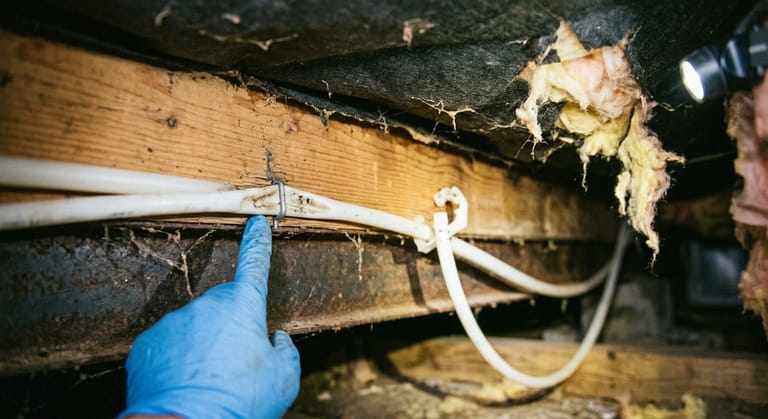
Support is the first thing to check down there. The federal ceiling on support spacing is 3 feet for horizontal plastic water piping, set by HUD in 24 CFR 3280.608(b), and whatever carries that pipe must not compress, cut or abrade it. The South Carolina Weatherization Field Guide gives crews a rougher number from below: gas, water and electrical lines fastened to a joist or framing member at 4 foot spacing or tighter.
Crossovers are the other classic. Where two sections join, the standard has the manufacturer supply fittings or connectors for the water piping, and Census counted 58,251 of the 103,314 homes shipped in 2024 as multi section. That link sits lower and colder than anything else in the run.
A torn belly wrap turns into a water pressure problem. A torn or missing underbelly sits high on the weatherization testing list of air leak sites here, another way of saying the pipe inside now lives outdoors. Cold pipe throttles before it bursts, so chase a thin winter stream while it is still [a line starting to freeze](/frozen-pipes/).
Photograph what you find and let a licensed pro price it from the picture.
When the pipe itself is the answer
Sometimes nothing is blocked and the material is simply old. ACS 2024 one year estimates put roughly two thirds of occupied manufactured homes as built before 2000, and the HUD material list at 24 CFR 3280.609(d)(1) runs from brass and galvanized steel through Type K, L and M copper to listed plastics. What sits under a 1985 floor is not what sits under a 2015 one.
Nobody ever struck polybutylene from the standard. It is there in today's text at 24 CFR 3280.604(c)(3) as ASTM D3309, and the PEX entries beside it were brought current by HUD's rule of December 2013. Either can be repiped, and here that is routine rather than exotic work.
What the clock costs. Plumber time runs $45 to $150 an hour in HomeGuide's national repair figures, and a shop that bills a minimum for showing up sets it between $50 and $200. Those cover all housing types. Here the unit prices sit low and the access charges sit high, because the work happens on someone's back in a crawl space.
A repipe is planned work, not an emergency. Get the scope walked and written down first, then weigh it against what a plumbing repair on these homes involves.
Where your end of the job stops
Reasonable to do yourself
- Gauge the hose bib, log the reading
- Clean or swap aerators and heads
- Open every stop fully, label the main valve
- Inspect the crawl with a flashlight and a phone
Hand over without apology
- Any fitting on the water heater or its vent
- Cutting into a water line under the floor
- Fitting or replacing a pressure reducing valve
- Repiping a section, or the whole home
Haverlane reports on manufactured housing, and the wrench work belongs to somebody else's trade. (800) 555-0176 reaches a plumbing partner who has chased weak water pressure out of a crawl space before, it costs nothing to call at any hour, and the price is settled between you and that plumber. Read out the gauge figure and name the weak taps, and half the visit is finished before anyone parks. Booked work can send a referral fee back to Haverlane, paid on the partner's side and never built into your bill.