What Size Are Mobile Home Water Lines, and Which Tanks Fit
The short version
- The federal table allows 3/8 inch outside diameter on a branch feeding one fixture, and caps that run at 6 feet.
- Five or more fixtures on one run means 3/4 inch nominal, which is also the thread at the fresh water inlet.
- The 19 and the 20 gallon tank are one body: 19 gallons nominal, 17 rated, a single 2,500 watt element on 120 volts.
- None of the five manufactured housing brands builds a 50 gallon electric unit. At that capacity it is gas, on a 22 inch shell.
- Plastic supply piping must be listed for hot water, and polybutylene is still named in 24 CFR 3280.604.
Under the HUD code a supply branch feeding one fixture can be 3/8 inch outside diameter, and a run feeding five or more fixtures takes 3/4 inch nominal. Those sizes are federal minimums out of 24 CFR 3280.609(f)(1), not a description of what your factory chose. Tank sizes behave the same way: several catalogue numbers are real, and one famous one is not. Rather have the water lines measured for you? (800) 555-0176 is free to dial and puts you with a licensed plumber who does manufactured housing work.
What size are mobile home water lines under the HUD table
Federal law sets a floor, not a recipe. The standard at 3280.609(f)(1) says supply piping and branch lines shall not be less than the sizes in its table, keyed to how many fixtures a run has to feed.
| Fixtures on the run | Nominal tubing, in. | Outside diameter, in. | Iron pipe size, in. |
|---|---|---|---|
| 1 | 1/4 | 3/8 | 1/2 |
| 2 | 3/8 | 1/2 | 1/2 |
| 3 | 1/2 | 5/8 | 1/2 |
| 4 | 1/2 | 5/8 | 1/2 |
| 5 or more | 3/4 | 7/8 | 3/4 |
The asterisk on the first row carries a footnote worth reading twice: 6 foot maximum length. The smallest tubing in the standard is a stub to one fixture, never a trunk. Exceptions follow for laundry and dish machines, which take the two fixture sizes unless the maker asks for more, and for galvanized screw piping, which never drops below 1/2 inch iron pipe size.
Running a tape across the outside of the tubing is owner work. Judging whether a starved branch wants one fitting or a repipe is a call for someone who crawls bellies.
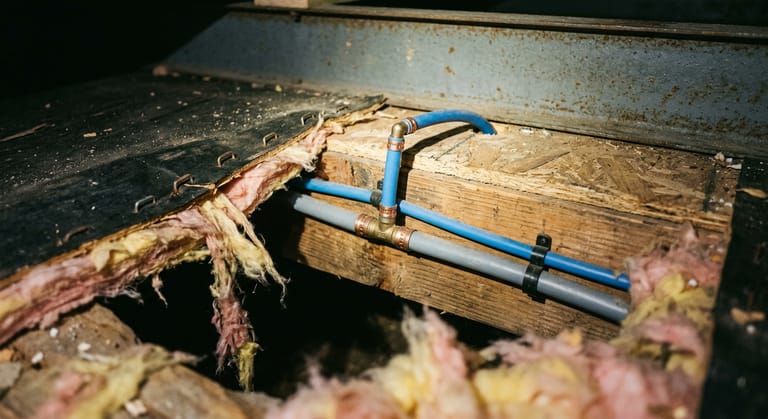
The 3/4 inch inlet, 80 psi, and the crossover
Every unit with a distribution system carries a 3/4 inch threaded inlet, tagged Fresh Water Connection or Fresh Water Fill, under 24 CFR 3280.609(b)(1). That thread answers the feed question: 3/4 inch at the skirting, tapering inward.
The same paragraph covers two more things. Where no master cold shutoff sits accessibly on the feeder, the instructions must put one in the supply line beside the structure, which is why the main valve often lives outdoors. And where a unit ships in two sections, purpose built fittings join the piping. That crossover is the run that freezes first.
Materials, and what may replace what
Section 3280.609(d)(1) accepts brass, galvanized steel or wrought iron, copper tubing in Types K, L and M, and approved or listed plastic. Then comes the clause a weekend repair usually breaks: plastic piping and fittings must be listed for use with hot water.
The plastics named in 24 CFR 3280.604(c)(3) tell the era story. CPVC sits there under ASTM D2846, PEX under ASTM F876 and F877, and polybutylene is still listed under ASTM D3309. HUD brought the PEX references current in a final rule published 9 December 2013 at 78 FR 73966.
- Support. Horizontal plastic water lines need a hanger every 3 feet, drainage every 4 feet, per 3280.608(b).
- Separation. Piping and wiring must not share a hole through a floor or wall, and plastic stays clear of heat producing appliances.
- Proof. The finished system takes air or water at 80 psi plus or minus 5 psi for 15 minutes with no loss, per 3280.612(a).
Washington State treats a polybutylene repipe as a permitted alteration with its own pre-inspection checklist, form F622-053-000. One state, not a national rule, but it reads like a field manual: penetrations foamed shut, insulation restored to the same R-value, the bottom board patched back. Fittings for that job sit in the parts notes, and the pressure test is the point where an owner hands off.
The drain side, where one outlet serves everything
Waste sizes follow the same instinct. 24 CFR 3280.610(c)(1) is blunt: one drain outlet per unit, 3 inches inside diameter or more.
Branch minimums run 1 1/4 inch for a lavatory, 1 1/2 inch for two or three fixtures, and 3 inch for water closets. Horizontal runs have to grade at least 1/4 inch per foot back to that outlet. The layout drawing makes that rule obvious, and the waste and vent notes carry it further.
Talk it through with a mobile home plumber
Call (800) 555-0176Free to dial. You reach a licensed plumber who works on manufactured homes.Partner plumbers who service manufactured homes- Plumbers who actually work on manufactured homes
- Line answered day and night, all year
- Dialing costs you nothing
- Price talk happens between you and the plumber
Is there a 19 gallon water heater for mobile home closets?
Yes, sort of. The name on the carton is the confusing part. The A. O. Smith ProLine EJCS-20 200 and the identical State ProLine ES6-20-SOMS 200 are sold as a 20-Gallon Specialty Compact Electric, while the spec table reads nominal capacity 19 gallons, rated storage 17 gallons, one 2,500 watt element, 120 volts, 18 inch diameter. Both carry a bullet claiming HUD compliance.
So the 19-gallon water heater for mobile home searches is real hardware. What it is not is a closet unit built for this housing type: none of the five brands lists a tank that size as a manufactured housing model. HUD compliant and purpose built are two separate claims.
What a 20 gallon electric water heater for mobile home use buys
A. O. Smith rates recovery on this body at 11 gallons per hour, and points the compact shape at installation under a counter, in a crawl space, or in other tight spots. That is a fair description of the job.
50 gallon electric water heater for mobile home: that size is gas
Flat no on the electric side. Reliance, State, A. O. Smith, Rheem and Richmond all publish manufactured housing catalogues, and not one of them lists a 50 gallon electric model. Electric stops at 40 gallons, which makes the 40 gallon electric tank the ceiling on a breaker.
At 50 gallons the choice is gas. The A. O. Smith ProLine FMDV-50 250 lists 47 gallons rated storage, 40,000 BTU, a 67 gallon first hour rating, 57.25 inches tall and 22 inches across. Richmond offers its Essential Direct Vent Co-Axial at 40 and 50 gallons, rated 65 gallons in the first hour.
Geometry decides the rest. A 30 gallon direct vent shell measures 18 inches across against 22 at 50, and the combustion air duct steps from 3 inch to 4 inch. Moving up two sizes is a closet rebuild, not a swap.
Where measuring stops and the phone starts
Reading the size table, checking pressure with a gauge, measuring tubing and the closet opening, and matching a rating plate against a spec sheet are owner jobs that sharpen any quote.
Cutting into a starved branch, repiping water lines under the belly, jumping two tank sizes, or touching gas and 240 volt connections is where it stops. Dialing (800) 555-0176 costs nothing, and the plumber who picks up is licensed and spends the week under manufactured homes. Have your tubing diameter and the closet door width ready. More sits in the tank section.