Installing a Water Heater in a Mobile Home, Start to Finish
The short version
- HomeGuide's 2026 pricing puts a tank swap at $600-$3,100 installed: $500-$1,900 at 30 gallons, $600-$3,000 at 40, $700-$3,100 at 50.
- The HUD code requires every appliance to be installed to the terms of its own listing, which is what rules out a unit listed only for site built houses.
- A. O. Smith's manufactured housing manual allows zero clearance at the sides but 4 inches from the jacket front to the door, so body diameter decides everything: 18 inches at 30 gallons, 20 at 40, 22 at 50.
- The roof jack kit is a separate order sized to vent length, and HomeGuide prices vent replacement at $100-$600 and a new dedicated circuit at $250-$900.
- Gas piping, the vent and any 240 volt circuit change belong to a licensed pro. Shut the fuel or the breaker off before anything else moves.
A mobile home water heater installation runs $600 to $3,100 installed on HomeGuide's 2026 national tank numbers, and it only goes smoothly when the replacement unit is certified for manufactured housing.
Everything else follows from that purchase: closet width, roof jack, drip pan, side water connections. Buy the wrong box and the afternoon becomes carpentry.
Haverlane publishes and does not turn wrenches. The number here reaches a licensed plumber who treats manufactured housing as ordinary work, and a booked job can pay Haverlane a referral fee that never reaches your invoice.
What the HUD code settles before you pick a unit
Two sentences in the federal standard end the argument. A listed water heater is what 24 CFR 3280.609(a)(2) expects inside the hot water supply system it mandates. Then 24 CFR 3280.709(a) settles it: an appliance is installed properly only where the work follows "the terms of its listing and the manufacturer's instructions".
A water heater listed only for site built houses has no terms covering this dwelling, so it cannot be installed to its listing here. That is why manufacturers run a separate certified line, not a sticker variant.
Gas raises the bar. Section 3280.709(d) sets one condition, met two ways: the combustion system and indoor air stay entirely apart, via a sealed combustion appliance or an enclosure with no opening into the living space.
Read the certification on the water heater you are quoted, not the aisle sign. The rules behind a HUD approved unit take two minutes to check, and a partner plumber will walk them with you.
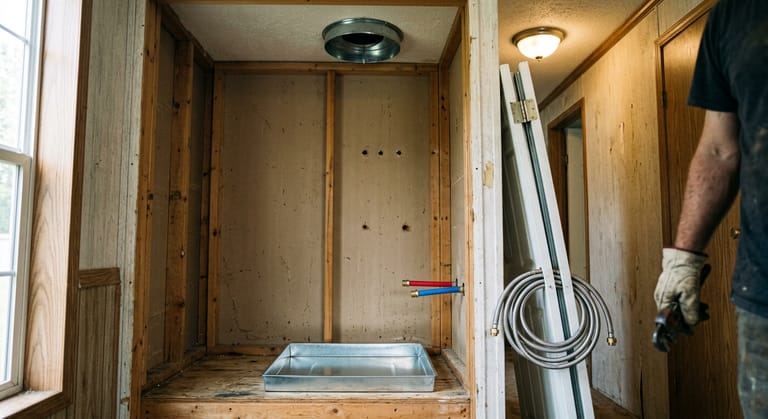
Measure the closet, then buy the water heater
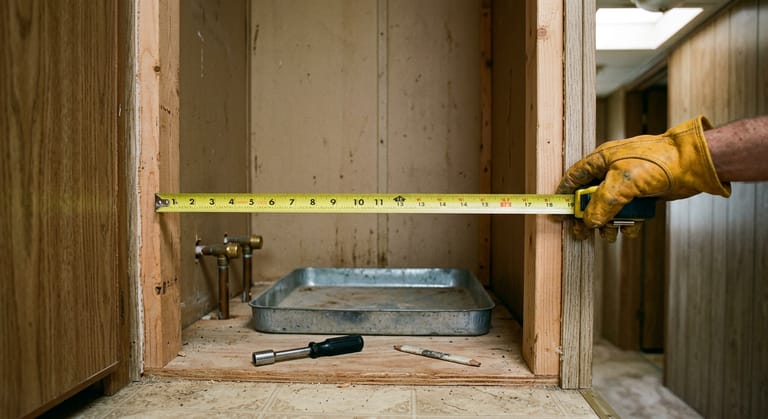
The compartment was framed to the appliance, not to a standard. Sides and back may touch, 0 inches, in A. O. Smith's manufactured housing manual. The jacket front owes the closet door 4 inches, the jacket top owes combustible material 27 inches, and service wants 24 inches out front.
Zero at the sides is the trap: body diameter becomes the only dimension that matters, and it grows with capacity. Rows below come from A. O. Smith spec sheets, except the last from State.
| Body | Diameter | Height | Model |
|---|---|---|---|
| 30 gallon gas, direct vent | 18 in. | 58.25 in. | FMDV-30 250 |
| 40 gallon gas, direct vent | 20 in. | not published | FMDV-40 |
| 50 gallon gas, direct vent | 22 in. | 57.25 in. | FMDV-50 250 |
| 28 gallon electric lowboy | 22 in. | 30 in. | EMHL-30 100 |
| 40 gallon electric | 22 in. | 49.75 in. | EN6-40-DMHS 100 |
Two extra inches of diameter is a rebuild, not a swap. Going from a 30 gallon gas body to a 50 also takes the combustion air duct from 3 inches to 4 on that direct vent line, moving the floor penetration. Measure before ordering.
The 9 steps of mobile home water heater installation
- Read the data plate. Three hiding places, per HUD: a kitchen cabinet, the electrical panel, or a bedroom closet. Paper, the size of a standard sheet, naming factory installed appliances by model.
- Measure the compartment. Width first, then door opening, then height above the jacket.
- Order unit and vent kit together. A. O. Smith sells four roof jack kits by vent length, 12 inches through 36 to 95 inches, ordered separately.
- Kill the fuel or the power. Close the appliance gas valve, or the breaker on an electric water heater, before a fitting is touched.
- Close the water, drain the tank. HUD's installation standard at 3285.603(c) wants an accessible shutoff between supply and inlet, so find that valve first.
- Disconnect and extract. Most units leave through the exterior compartment door, which is why that door exists.
- Pan down first, water heater onto it. 3280.709(h) wants that drip pan corrosion resistant, draining outdoors or into a drain.
- Secure it. The manual specifies three brackets screwed into floor and enclosure wall, held against displacement yet still removable.
- Reconnect, then test. Water, relief discharge, combustion air, vent, fuel or power last, then a leak check under pressure.
Steps 1, 2 and 5 are owner work and save money. Steps 3, 4 and 9 touch gas piping, a roof penetration or a live circuit, so they belong with a licensed plumber. Call (800) 555-0176 free and read out your numbers.
What mobile home water heater replacement cost looks like in 2026
Most of the spread in a quote for mobile home water heater installation comes from access, not the tank. HomeGuide's 2026 data below is national and covers all housing types, a baseline only.
| Line | HomeGuide 2026 |
|---|---|
| Tank swap, installed | $600-$3,100 |
| 30 gallon, unit / installed | $300-$900 / $500-$1,900 |
| 40 gallon, unit / installed | $400-$2,000 / $600-$3,000 |
| 50 gallon, unit / installed | $500-$2,100 / $700-$3,100 |
| Labor, same size exchange | $200-$1,000, 2 to 6 hours |
| Cramped access, per labor hour | $125-$300 extra |
| Vent replacement | $100-$600 |
| New dedicated circuit | $250-$900 |
The way to shrink the number is a like for like exchange: same fuel, same capacity, same diameter, same vent path. Every deviation opens another line on the estimate.
Talk it through with a mobile home plumber
Call (800) 555-0176Free to dial. You reach a licensed plumber who works on manufactured homes.Partner plumbers who service manufactured homes- Plumbers who actually work on manufactured homes
- Line answered day and night, all year
- Dialing costs you nothing
- Price talk happens between you and the plumber
What mobile home hot water heater installation adds that a house swap does not
Hookup is where the two jobs stop resembling each other. Cold water enters at the side and hot leaves at the top on these gas units, as Reliance describes its 2026 line: supply arrives from under the floor, not through a wall.
Electric bodies from Reliance and State put both connections on the side. Richmond's direct vent co-axial for manufactured housing is the exception, listed with 3/4 inch hot and cold top connections, so the side rule is a habit and not a law.
The relief valve sits on the side of these bodies, and A. O. Smith's spec sheet rules a top mounted T&P out, no option offered. That fixes the discharge route, and the code at 3280.609(c)(1)(iii) is strict: piped full size to the exterior, explicitly not underneath the dwelling, ending 6 to 24 inches above grade, not trapped, outlet unthreaded and visible.
Gas day and electric day are different jobs
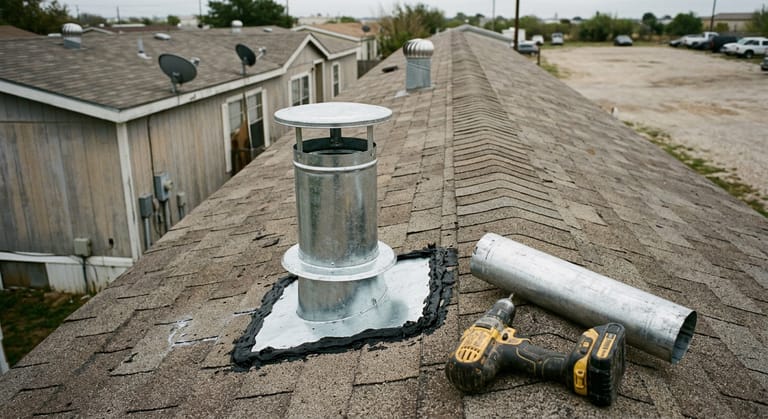
On gas, the vent kit and the combustion air path drive the schedule. Outside air is mandatory on the A. O. Smith line: a 3 inch intake duct on the 30 and 40 gallon bodies, a 4 inch duct on the 50. Over a basement or crawl space, that PVC intake may total 30 feet and turn no more than 3 elbows.
Fuel flexibility is a real advantage. Every model from that manufacturer ships on natural gas, a propane burner in the box for converting; on the 30 gallon body propane rates lower, 29,000 BTU against 30,000. Altitude limits are brand specific, so ask before buying.
Electric raises a different question: what is on the circuit now. These water heaters sell at 120 volts and 240 volts, with elements from a single 1,500 watt up to dual 4,500 watt. Richmond publishes it as recovery: at a 90 degrees F rise, 3,500 watts returns 17 gallons per hour and 4,500 watts returns 21.
Repair or replace, and the honest cutoff
Roughly 8 to 12 years is HomeGuide's tank life, up to 15 where maintenance happens, and past 10 years its advice is to replace, sooner once a repair quote reaches half the price of a new unit. Its national repair sample averages $455 inside a $150-$700 band.
Run that against the swap table and the answer is usually obvious. A thermocouple, $100-$325 on HomeGuide's list, is worth doing on a 6 year old water heater; a $150-$550 gas control valve on a 14 year old one is not. Manufactured housing lines also carry only a 6 year limited tank warranty across all four major brands, so that clock runs faster than owners expect. Our page on what actually fails first walks the symptom list.
What an owner can do, and where to stop
Reasonable to do yourself
- Photograph the data plate and its appliance list
- Measure diameter, door width and height above the jacket
- Locate and test the main shutoff valve
- Clear the compartment and the path out
- Note the model number and the warranty date
Hand to a licensed plumber
- Any gas connection, valve or leak test
- The roof jack and combustion air duct
- 240 volt wiring and breaker sizing
- Relief discharge routing to the exterior
- Anything that needs a permit pulled
Doing the first column well shortens the second. A plumber who arrives knowing diameter, fuel and vent length quotes in one visit, not two.
Talk it through before the tank is on the truck
The cheapest mobile home water heater installation is the one where the right box arrives first time. Have the old unit's model, the closet width and the vent route ready.
Call (800) 555-0176. Dialing costs nothing, a licensed plumber who works on manufactured housing answers, and price is settled between the two of you before tools come out. If a standard tank was fitted at some point, our comparison of the two appliance types says what to check.