The mobile home water heater door, and why it opens outdoors
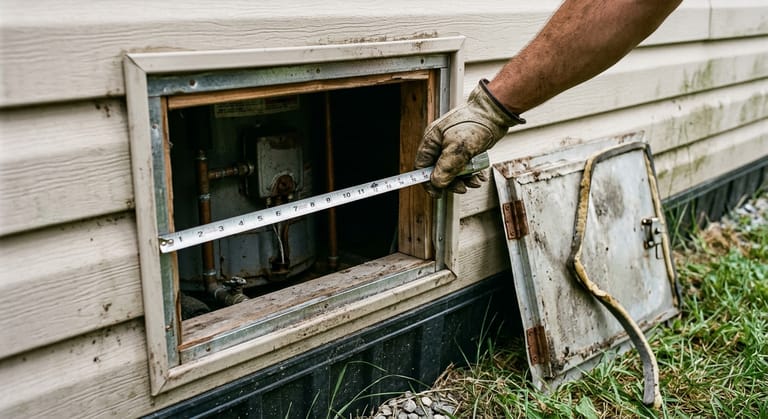
A mobile home water heater door sits on the outside wall because 24 CFR 3280.709(d) bars every way into a gas appliance enclosure from indoors. No door, no removable access panel, no opening of any other kind. Seal that closet off from the living space and the siding is the only face left to reach the tank.
That is where the panel low on the wall comes from, and why a missing one matters.
Why the panel sits on the outside wall
HUD's construction standard draws a hard line: burner air and the air people breathe indoors may never be the same air. Separation of burner and venting from the home's interior atmosphere must be total, by one of two routes.
Route two puts a panel on the siding, and the code says so: its interior finish rule at 3280.203 lists a combustible door onto a water heater space among the surfaces that must be limited combustible.
Not every manufactured home has one
Paragraph 3280.709(d) is written about fuel-burning appliances, so an electric tank never falls under it and often sits in an interior closet behind an ordinary door. Gas is where the fork opens.
A sealed combustion unit satisfies the rule by its own construction, not its closet. Richmond sells that point: its Essential Direct Vent line for manufactured housing is advertised as needing no external door. An atmospheric model leans on the enclosure method instead, which is why it arrives with a sealed closet and a way in from outdoors.
So the first question is which appliance you own. If the tank is still hiding, where the water heater usually sits covers the fastest way to find it.
What the code lets the door be
A mobile home water heater door answers to three requirements before any catalogue. Limited combustible is the first, louvers included. Second, 3280.713 keeps the tank open to inspection, service, repair and replacement without pulling out permanent construction. Third, 3280.709(b) guards the front of the appliance, where no door, drape or similar material may sit or swing nearer than the label's clearances.
Manufacturer instructions set the inches. A. O. Smith's manual for its manufactured housing direct vent line gives:
| Measured from | Minimum |
|---|---|
| Sides and back | 0 in. |
| Jacket front to closet door | 4 in. |
| Jacket top to combustibles | 27 in. |
| Vent clearance | 6 in. |
| Front service clearance | 24 in. |
Zero at the sides and back is not generosity. The compartment was built around the tank that shipped in it, so an inch of extra diameter has nowhere to go.
Talk it through with a mobile home plumber
Call (800) 555-0176Free to dial. You reach a licensed plumber who works on manufactured homes.Partner plumbers who service manufactured homes- Plumbers who actually work on manufactured homes
- Line answered day and night, all year
- Dialing costs you nothing
- Price talk happens between you and the plumber
Measuring before you order a replacement
Measure the framed opening and the appliance in that order: a panel that fits the hole is useless if the tank cannot pass.
- Shut the fuel or the power off first. Gas closed at the appliance shutoff, or the breaker off on an electric unit, before a hand goes in.
- Measure the framed opening, not the old panel. Width, height, corner to corner for square, then the flange overlap on the siding.
- Record the swing and the latch side. Hinge left or right, and how it seals against weather now.
- Check what has to travel through it. A. O. Smith's manufactured housing spec sheet puts the gas bodies at 18 in. diameter for 30 gallons, 20 in. at 40 and 22 in. at 50, so the opening can rule out an upsize.
- Photograph the labels inside. The rating plate names the appliance, and the compartment may carry the 3 in. by 5 in. no-storage label from 3280.709(c)(2)(iii).
Hanging a like-for-like panel is homeowner work. Cutting a new opening, moving the closet or changing the appliance is not, and a plumber used to this housing can tell you which one you have over the phone.
What an open compartment lets in
A panel left off, or propped with a brick all winter, turns an enclosure into a wind tunnel. The federal installation standard names this space: in areas subject to freezing, 24 CFR 3285.603(d)(2) counts piping in a water heater compartment among the runs that must be insulated or otherwise protected from freezing. Same reasoning as the rest of the winter list.
Two habits follow a missing panel: storage, which that label exists to prevent, and carpet, which 3280.205 bars from any space designed to hold only a furnace or water heater. Both stack combustibles against a hot appliance.
The heater panel is not the skirting hatch
Owners and suppliers call both openings the access panel, which sends people to the wrong part. The skirting hatch answers to 24 CFR 3285.505(e): 18 inches minimum on width, 24 on height, three square feet on area, positioned to reach the utility connections under the home.
That one reaches the belly, the shutoff and the crossover. The water heater door for a mobile home reaches the appliance. Different rule, different part.
What the work costs, and where to stop reading
No national price series follows this panel alone. The job it comes off for does have numbers: a standard tank replacement runs $600 to $3,100 installed in HomeGuide's 2026 figures.
Order a panel, hang it square, keep it latched: that part is yours. The gas appliance behind it, the vent, a lost service clearance or a tank too wide to pass is licensed work, and what a manufactured home water heater installation involves sets out why.
Dialing (800) 555-0176 costs nothing, and whoever answers is a licensed plumber for whom manufactured housing is routine, at any hour. Describe the panel, the tank and what the compartment smells like: a few minutes settles whether you need a part or a visit.
Talk it through with a mobile home plumber
Call (800) 555-0176Free to dial. You reach a licensed plumber who works on manufactured homes.Partner plumbers who service manufactured homes- Plumbers who actually work on manufactured homes
- Line answered day and night, all year
- Dialing costs you nothing
- Price talk happens between you and the plumber