Where the hot water heater in a mobile home actually sits
Usually behind a hatch on the outside wall: a gas hot water heater in a mobile home sits in a closet sealed off from the rooms. Electric tanks are the exception and often stand in a hallway closet, a utility nook or the laundry corner.
The roof and the data plate usually settle it, and neither needs a tool.
The federal rule that pushes the tank outdoors
Gas appliances in manufactured housing may not share air with the rooms. 24 CFR 3280.709(d) accepts two ways of achieving that: a sealed combustion unit, or an enclosure. Take the enclosure route and the paragraph shuts every path inward: no door, no removable panel, no other opening from inside, and any hole left for ducts, piping or wiring sealed.
With every inward path shut, the siding is the only face left. Section 3280.203 assumes exactly that when it caps how combustible an outdoor door onto a water heater space may be, louvers included.
Missing, warped or screwed shut, the access panel carries its own code requirements, down to what it may be built from.
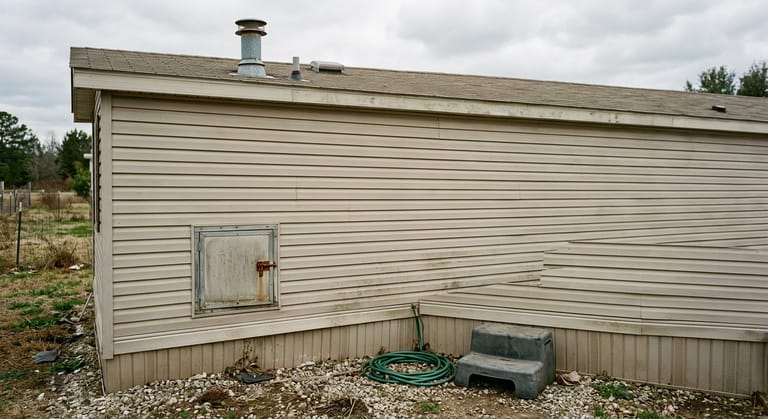
Mobile home water heater location, the three usual spots
| Spot | Usually holds | Quick confirmation |
|---|---|---|
| Compartment opened from the siding | Gas, atmospheric or direct vent | A hatch low on the exterior wall, a vent cap on the roof above it |
| Hallway or utility closet indoors | Electric, or a sealed combustion gas unit | An ordinary door, and a breaker marked for the tank |
| Under a counter or in a shallow alcove | Compact and lowboy bodies | A stubby tank: A. O. Smith's 28 gallon lowboy is 30 inches tall, 22 wide |
That third row surprises people in the field. A. O. Smith's 19 gallon compact body, sold under a 20 gallon name, is pitched at tight spots on its side connections: beneath a counter, or out in the crawl space.
Four checks that name the water heater you own
- Look up before you crawl. Under 3280.710(a) the venting has to be a listed system, roof jack included, and A. O. Smith sells four direct vent roof jack kits sized by vent length. A cap over the closet means fuel burns below, though the furnace has one too.
- Find the data plate. HUD describes it as a paper label 8 1/2 by 11 inches, posted in a kitchen cabinet, an electrical panel or a bedroom closet.
- Read its appliance list. 24 CFR 3280.5 requires that plate to name major factory installed equipment, maker and model of each appliance, so your original tank is named there.
- Glance at the breakers. A circuit labelled for the tank points indoors. Both voltages exist here: Reliance lists a 120 volt, 3,000 watt model, State a 240 volt one with two 4,500 watt elements.
Looking is yours. Opening a sealed gas enclosure, moving an appliance or adding a circuit is not, and a partner plumber used to manufactured housing can name your setup from a description.
Talk it through with a mobile home plumber
Call (800) 555-0176Free to dial. You reach a licensed plumber who works on manufactured homes.Partner plumbers who service manufactured homes- Plumbers who actually work on manufactured homes
- Line answered day and night, all year
- Dialing costs you nothing
- Price talk happens between you and the plumber
What the mobile home water heater compartment holds
Gas tanks built for this housing take cold supply into the side and hand hot water off the top, because the supply rises from below the floor. Electric bodies carry both connections on the side, along with the relief valve.
The space carries rules of its own. Carpet is out under 3280.205 wherever a compartment was built for the appliance alone. The current text of 3280.709(h) wants a corrosion resistant pan below the tank, piped so a leak reaches outdoors or a drain. Where the space is not framed in, 3280.709(c)(2)(iii) adds a 3 inch by 5 inch label telling everyone to store nothing in there.
When the tank ends up somewhere it should not be
Remodels move walls and closets get absorbed. The code answer is short: 3280.713 requires every appliance to stay accessible for inspection, service, repair and replacement without removing permanent construction, with room to watch the burner and controls while starting it.
Two smaller traps follow. Paragraph 3280.709(b) keeps doors, drapes and the like from sitting nearer the appliance front than its label allows, which is where added coat hooks and shelving fall foul. A. O. Smith's manual also asks for 24 inches of front service clearance, so a doorway rehung the wrong way can strand a good unit.
Clearing stored boxes out is homeowner work. Anything structural stops there.
Find the shutoff on the same trip
Under 24 CFR 3285.603(c) an identified, reachable shutoff belongs between the supply and the inlet, with its riser under the structure or right beside it, and the valve has to be full flow: a gate, a ball, or the equivalent. Track down the main shutoff valve on a manufactured home now, not on the night it is needed.
Worth rereading in winter: 3285.603(d)(2) puts pipes in water heater compartments on the list of runs needing insulation or other freeze protection anywhere the weather goes subfreezing.
Why the spot decides part of the bill
A straight tank swap runs $600 to $3,100 installed in HomeGuide's 2026 numbers, and it prices harder work at $125 to $300 an hour of labor, with cramped closets on its list of what makes a job harder. Every spot in the table above is that closet.
Found the hatch and cannot make sense of what is behind it? (800) 555-0176 is free to dial, and the person answering fixes manufactured housing plumbing for a living, nights included. Describe the wall, the roof and the breaker panel: a couple of minutes usually settles where your hot water heater in a mobile home is hiding.
Talk it through with a mobile home plumber
Call (800) 555-0176Free to dial. You reach a licensed plumber who works on manufactured homes.Partner plumbers who service manufactured homes- Plumbers who actually work on manufactured homes
- Line answered day and night, all year
- Dialing costs you nothing
- Price talk happens between you and the plumber