Mobile Home Tankless Water Heater: What Fits and What Does Not
The short version
- No tankless body is listed for manufactured housing. The catalogues behind the four maker sites in this segment carried storage tanks only when they were read in August 2026.
- The deciding sentence is 24 CFR 3280.709(a): an appliance goes in on the terms of its own listing, or it does not go in. A badge claim is not a listing.
- Venting kills most conversions. Section 3280.710(c) forbids any vent terminating under the home, and 3280.709(d) demands the combustion system be sealed off from the air inside.
- The code is not blind to the idea: it already incorporates ANSI Z21.10.3, the standard covering instantaneous gas units above 75,000 BTU per hour.
- HomeGuide 2026 puts conversion labor alone at $600-$2,500, then charges $125-$300 more per labor hour where the closet is tight, and $350-$2,000 if the gas line has to grow.
No manufacturer builds the mobile home tankless water heater. The four catalogues serving this housing were read in August 2026 and carry storage tanks only, so a conversion gets settled one model at a time, on three questions with federal answers.
Those three: the listing, the vent route, and whether your fuel line or panel can feed a much bigger burner.
Nobody lists a tankless body for manufactured housing
What these lines publish is storage. Reliance's 2026 spec sheet puts natural gas input at 30,000 BTU on the 30 gallon and 40,000 on the 50. A. O. Smith prints FOR USE ONLY IN MANUFACTURED HOMES across the cover of its direct vent manual.
Reliance, State and A. O. Smith are three labels on one corporate house, and Richmond belongs to Rheem, so the shelf holds fewer engineering teams than it looks. None publishes an instantaneous body.
A candidate therefore arrives as an ordinary residential appliance, and 24 CFR 3280.709(a) is blunt: an appliance goes in on the terms of its own listing and its maker's instructions, or it does not go in. That sentence decides the job, not the sticker.
Your part is short: photograph the rating label and the data plate, and note the fuel. Judging whether a listing survives that paragraph is not homeowner work, and reading the manual with a licensed plumber costs nothing at (800) 555-0176.
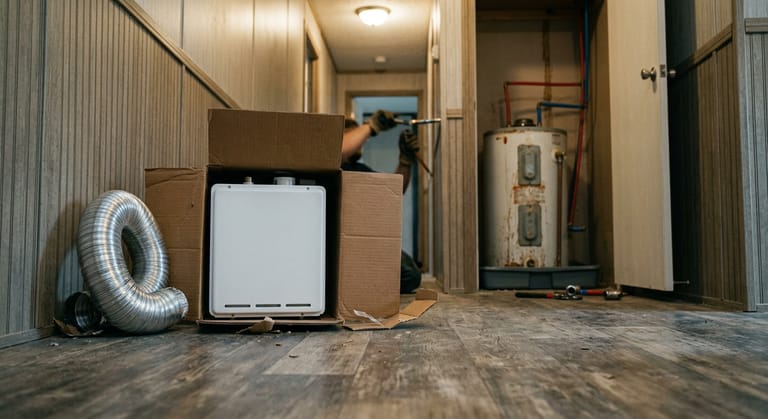
Is there a HUD approved tankless water heater built for a mobile home?
Not as a catalogue item. HUD stamps no appliance one by one. The code asks any home with a sink and a tub or shower to carry a listed heater on its hot water system, and 3280.707(a) now leaves that to a nationally recognized testing agency, which must have listed or certified the appliance and its vent for residential use. Until September 2025 that sentence asked for listing for use in manufactured homes.
Instantaneous is no foreign word in this code either. One gas standard it already incorporates, ANSI Z21.10.3, puts that word in its own title, next to circulating, for input ratings above 75,000 BTU per hour.
HUD's July 19, 2022 fact sheet said the proposed rule would allow gas-fired tankless units without HUD alternative construction approvals. The final rule followed on September 16, 2024, with the plumbing amendments in force from September 15, 2025. Haverlane has seen no HUD document confirming how that item landed in the final text, so read the 2022 sheet as intent and let the model's listing answer. What approval covers, and what it never does, sits on the HUD approval page.
Stop where an owner should: a seller's phrase is not a listing, and nobody orders before someone licensed has confirmed where the exhaust may legally go.
Tankless, on demand, or a mobile home tankless hot water heater
Three names, one appliance. Water gets heated as it flows, the stored gallons vanish, and with them the reason this compartment has its shape.
The drip pan paragraph at 3280.709(h) names a storage tank-type water heater or a hot water storage tank, while the wording in the 2025 annual edition was simply under each water heater. Pressure relief does not move at all. A listed automatic relief valve still sits on every water heater, its discharge piped full size to open air rather than under the floor, finishing 6 to 24 inches above grade, untrapped, unthreaded at the outlet, and left visible.
Which of those an inspector enforces varies by jurisdiction, so ask first. A relief line stubbed into the belly is a defect somebody must redo.
The vent is where most conversions die
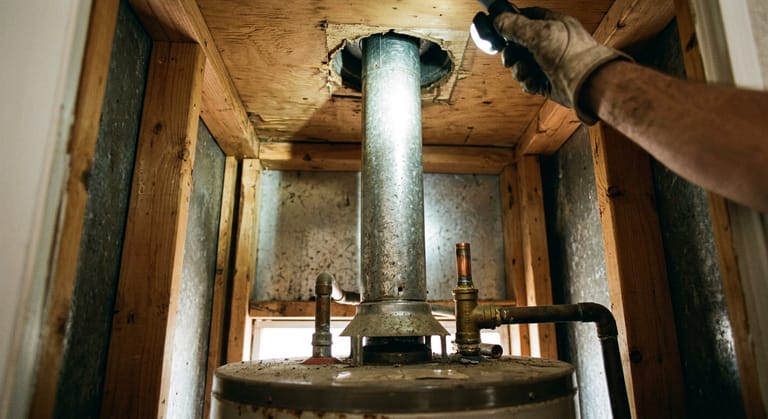
Every fuel burning appliance here answers to Section 3280.709(d), which demands total separation: the air a burner uses may never be the air people breathe indoors. Two builds get there, a sealed combustion direct vent unit or an enclosure with no opening into the living space. A louvered interior closet fails both.
The vent divides the same way: it comes listed as part of the appliance, or every piece of the run carries a listing, roof jack included, and that fitting has a manufactured home standard of its own, UL 311.
One rule settles the commonest mistake. Section 3280.710(c) admits no exception: the underside of a manufactured home is no legal terminus for a vent. The installation standard says the same of a vent leaving through the floor, which must carry on past any skirting into open air. Shut the gas at the appliance valve, kept within 3 feet of the unit, and leave venting and gas piping to a licensed professional.
Reconnaissance is fair homeowner work: find where the present vent leaves, and whether the compartment opens from outside or a hallway. The rest is licensed, and decides whether the job is possible. A step by step replacement install shows what a legal route looks like.
Talk it through with a mobile home plumber
Call (800) 555-0176Free to dial. You reach a licensed plumber who works on manufactured homes.Partner plumbers who service manufactured homes- Plumbers who actually work on manufactured homes
- Line answered day and night, all year
- Dialing costs you nothing
- Price talk happens between you and the plumber
What the panel and the gas line were built for
Electric first. The code's referenced electric standard is UL 174, Household Electric Storage Tank Water Heaters, and an instantaneous unit stores nothing. So 3280.603(a)(5) takes over, and a testing laboratory carries it: no listing of the piece as suitable for the intended use, no place in this housing.
Then the load. This housing was wired around modest appliances. Reliance still catalogues single element bodies drawing 1,500 watts on 120 volts. The HUD load calculation counts nameplate amperes into the home total and holds a fixed appliance to half a circuit rating where lighting outlets share it.
Gas next. The fuel system is designed for 7 to 14 inches of water column and sized around those 30,000 to 40,000 BTU appliances, while Z21.10.3 starts above 75,000 BTU per hour. Propane adds 3280.707(c): a burner crosses from one fuel to the other only where its own listing allows.
Close the gas valve, switch the breaker off and test it dead before any cover comes off. Sizing a circuit or a fuel run is not a forum decision.
What a tank to tankless conversion costs
Conversion pricing is where this mobile home tankless water heater idea meets the ground. HomeGuide's January 2026 figures are national, cover all housing types and carry no manufactured home series, so treat each row as a baseline, not a quote.
| Line item | HomeGuide 2026 | Why it bites in this housing |
|---|---|---|
| Conversion labor | $600-$2,500 | A half day to a full day on site, parts extra |
| Difficult access | $125-$300 per labor hour | The surcharge is written for cramped closets |
| Venting, first time | $500-$1,500 | A new route must clear the underside |
| Gas line upsizing | $350-$2,000 | Existing pipe was sized for a tank burner |
| Dedicated circuit | $250-$900 | Panels here start at 120 volt loads |
Against that, a like for like storage swap runs $500-$1,900 installed at 30 gallons. Service life leans the other way: HomeGuide's tankless range is 10 to 20 years, a tank's roughly 8 to 12, or 15 with maintenance.
Price the second column, not the first. Labor is rarely what breaks this budget. Venting, fuel capacity and the panel are, and each gets priced only after somebody has crawled the compartment. Get those three quoted before comparing against a straight swap, and see how far the appliances diverge on manufactured housing units against regular ones.
When the math survives, and when it does not
The appeal is real. Hot water capacity here is small by design: a 120 volt 40 gallon State model delivers 40 gallons in its first hour where the 240 volt twin posts 54. Households running cold halfway through a shower are not imagining it.
Worth pricing out
- Fuel piping or venting is being replaced anyway
- You plan to keep this home past the 8 to 12 years a tank gives
Walk away when
- The seller answers the listing question with the phrase HUD approved
- The proposed exhaust ends under the floor or inside the skirting
An emergency is the worst moment to convert. A same size replacement brings hot water back in an afternoon, and the conversion can wait for a warmer month.
Settle these four things before ordering anything
- Read the listing, not the ad. The candidate's manual has to permit this installation.
- Draw the exhaust route. It must reach outside air without ending under the floor or inside the skirting.
- Price the supply. Fuel capacity or a load calculation comes before the appliance, never after.
- Ask about relief and pan. Where the discharge terminates, and what your inspector wants beneath a heater with no tank.
The first two you can work out at the kitchen table. The last two are licensed work, and getting them wrong costs more than the appliance did. Dialing (800) 555-0176 is free at any hour, and the plumber who picks up spends the week in compartments like this one. Bring the photographs, the fuel type and the vent route, and the mobile home tankless water heater question stops being a guess.
Talk it through with a mobile home plumber
Call (800) 555-0176Free to dial. You reach a licensed plumber who works on manufactured homes.Partner plumbers who service manufactured homes- Plumbers who actually work on manufactured homes
- Line answered day and night, all year
- Dialing costs you nothing
- Price talk happens between you and the plumber