Electric Water Heaters Built for Mobile Homes
The short version
- Voltage is a real fork. State builds the same 40 gallon tank at 120 volts and at 240, and the first hour rating falls from 54 gallons to 40.
- Richmond publishes the wattage trade plainly: 17 gallons per hour of recovery at 3,500 watts, 21 at 4,500, both at a 90 degree F rise.
- Diameter kills more swaps than price. These bodies run 18, 19 and 22 inches across, and closets get framed tight around them.
- Nothing above 40 gallons exists as an electric manufactured housing model at A. O. Smith, State, Reliance, Rheem or Richmond.
- HomeGuide puts an installed swap at $500 to $3,000 by size, plus $125 to $300 per labor hour when the space is cramped.
An electric mobile home water heater runs on 120 or 240 volts, holds 19 to 40 gallons, and takes its water lines from the side rather than the top. Those three traits, not a sticker, separate it from the water heater on the hardware store shelf.
The rest is closet math and wattage. Dialing (800) 555-0176 costs nothing and reaches a licensed plumber who works on these homes every week.
What actually makes a tank a manufactured housing model
HUD's code asks that every manufactured home with a kitchen sink and a tub or shower carry a hot water supply system including a listed water heater, at 24 CFR 3280.609. For electric storage tanks the standard part 3280 points to is UL 174, Household Electric Storage Tank Water Heaters, the ordinary residential standard.
So there is no separate electric water heater listing to hunt for. What earns an electric mobile home water heater its label is HUD compliance plus a body shaped for the home, and the manufactured-home-specific certification lives on the gas side of the closet instead.
The shape part is concrete: Reliance describes a side mounted cold inlet and hot outlet for easy installation, and State calls the same thing a space saving design with side connections, both at 3/4 inch.
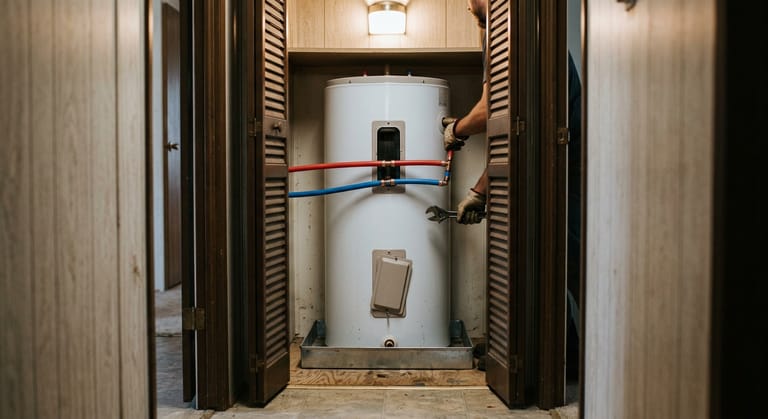
The electric sizes that exist, and one that does not
Five electric bodies cover almost every manufactured housing closet, and each row comes off the manufacturer's own product page.
| Nominal gal | Volts | Elements | First hour | Diameter | Model |
|---|---|---|---|---|---|
| 19 | 120 | one, 2,500 W | 11 GPH recovery | 18 in. | A. O. Smith EJCS-20 |
| 28 lowboy | 120 | two, 3,000 W | 47 gal | 22 in. | A. O. Smith EMHL-30 |
| 30 | 120 | two, 3,000 W | 50 gal | 19 in. | Reliance 6-30-DHMTK |
| 40 | 120 | two, 3,000 W | 40 gal | 22 in. | State EN6-40-DMHSW |
| 40 | 240 | two, 4,500 W | 54 gal | 22 in. | State EN6-40-DMHS |
Anyone shopping for a 40 gallon hot water heater for a mobile home is choosing between the last two rows: nothing bigger exists on the electric side at A. O. Smith, State, Reliance, Rheem or Richmond. Going past 40 means switching fuel.
Watch the outliers. The 19 gallon unit is sold under a 20 gallon name and is a compact point of use body. Reliance lists a 38 gallon table top with the HUD compliance bullet, but it is 24 inches across with top connections: compliant on paper, wrong shape for a closet. Work through what the gallon numbers actually measure first.
Watts, not gallons, decide when the shower comes back
Richmond states the trade in one line: recovery runs 17 gallons per hour at 3,500 watts and 21 at 4,500, both at a 90 degree F rise. That gap is what a second teenager feels on a winter morning.
Read the plate before you shop. Reliance builds a 40 gallon model with dual 3,800 watt elements, an odd rating that shows up mainly in the manufactured housing catalogue. Drop a generic 4,500 watt element in and the load stops matching what the circuit was sized for.
Wattage is not a free upgrade. HUD's electrical load calculation counts the appliance in the home's total nameplate amperes, and part 3280 holds a fixed appliance to 50 percent of a circuit rating when lighting outlets share it.
Copying volts, watts and element count off the plate is safe owner work. Sizing a bigger circuit is not. Shut the breaker off before opening any panel, and read the numbers to somebody if they do not add up.
A 3500 watt water heater for a mobile home
The 3,500 watt option is real and it sits at 240 volts. Reliance markets the 6-40-DHMSE as a 40 gallon 240 volt 3.5 kW model with two elements, a first hour rating of 40 gallons and UEF 0.91. Its 30 gallon sibling, the 6-30-DHMTE, carries the same wattage with a first hour rating of 50 and UEF 0.90.
Read that pair again. Reliance publishes the higher first hour figure on the smaller tank, the best argument there is for reading spec sheets instead of the number on the box.
A 3500 watt mobile home water heater suits a one bathroom household whose circuit was wired for exactly that. At Richmond's 17 gallons per hour, back to back showers feel the wait. When the second one runs cold, the fix is usually elements and voltage rather than a bigger tank, and a call settles that in minutes.
Talk it through with a mobile home plumber
Call (800) 555-0176Free to dial. You reach a licensed plumber who works on manufactured homes.Partner plumbers who service manufactured homes- Plumbers who actually work on manufactured homes
- Line answered day and night, all year
- Dialing costs you nothing
- Price talk happens between you and the plumber
A 120 volt water heater for a mobile home
This is the option site built lines almost never offer. State's ProLine EN6-40-DMHSW is listed as a 40 gallon 120 volt 3,000 watt unit: two elements, 36 gallons rated storage, a first hour rating of 40, UEF 0.91, 48.25 inches tall and 22 across. Reliance runs the same idea at 30 gallons in the 6-30-DHMTK, and A. O. Smith puts 3,000 watts into the 28 gallon EMHL-30 lowboy.
What 120 volts saves and costs. On the same 40 gallon tank, State rates the 120 volt version at 40 gallons in the first hour against 54 for the 240 volt one. Going the other way is not free: HomeGuide puts a dedicated circuit at $250 to $900 and a panel replacement at $850 to $1,700.
Then there is the slow end. Reliance builds single element 120 volt tanks at 1,500 watts, the 6-30-SHLK and the 6-30-SHMTK, the honest reason some manufactured homes never had much hot water. If that is yours, the question is whether the panel can carry 240 volts at all, and a plumber settles it in one visit.
One element or two, and what fails first
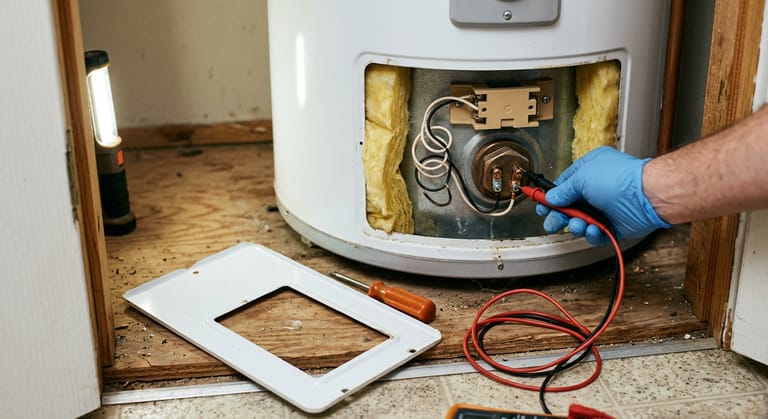
Element count changes how you diagnose the thing. HomeGuide ties a steady lukewarm supply to a failing upper element, and hot water that disappears fast to the lower one. On a single element 120 volt tank there is no upper or lower fork, which shortens the list.
Thermostats follow the same logic. HomeGuide describes a failed thermostat on a one element tank as no hot water; on a two element tank an upper failure means none, a lower failure means a short supply.
Power off first. Elements and thermostats sit behind panels on the side of the jacket, and terminals stay live until the breaker is off. Cut power, confirm it is dead, and leave 240 volt terminations to a licensed pro.
Most of what fails on an electric mobile home water heater is cheap. HomeGuide names element replacement the most common electric repair at $100 to $350, thermostats in the same band. If the breaker trips again after that fix, stop: it is a wiring symptom, and partner plumbers price the rest in symptom to part repair costs.
The code details that shape the install
Four federal requirements that follow the tank, not the fuel. HUD asks for a corrosion resistant drip and drain pan under each storage tank type unit. Every appliance must be secured in place against displacement while staying accessible and removable for servicing, so a tank cannot simply stand loose on the closet deck. Carpeting is banned in a space built to hold only a furnace or heater. And relief valve discharge must run full size to the exterior, never underneath the home, ending 6 to 24 inches above grade, pointed down and visible.
That last one is a common field violation. A discharge line dumped into the belly soaks insulation nobody looks at until the floor goes soft.
The valve setting is ordinary: HUD calls for relieving at 150 psi or the tank's rated working pressure, whichever is lower, at or below 210 degrees F. The whole sequence sits in the nine steps of a tank swap.
What a swap costs, and where an owner should stop
HomeGuide's figures are national and cover all housing types, so treat them as a baseline, not a quote. A 30 gallon runs $500 to $1,900 installed and a 40 gallon $600 to $3,000, priced model by model on the 40 gallon electric tanks, with labor at $200 to $1,000 for a same size swap. One line matters here: HomeGuide adds $125 to $300 per labor hour for installations that require accessing cramped spaces like closets. Removal adds $75 to $500, permits $50 to $200.
- Photograph the rating plate: volts, maximum wattage, element count, model number.
- Measure jacket diameter, overall height, and the narrowest point it must pass through.
- Check the pan is intact and the relief line runs outside, not into the belly.
- Drain and flush if it never has been, breaker off.
- Stop at the junction box. Circuit sizing, panel work and 240 volt terminations belong to a licensed pro.
Read the plate, then talk it through
Three numbers decide whether an electric mobile home water heater swap is a two hour job or a closet rebuild: nominal gallons, volts, and body diameter. With those in hand a plumber can say on the phone whether an equivalent tank exists and roughly what the day costs.
The number is (800) 555-0176, it costs nothing to use, and the line is staffed overnight as well as midday. Haverlane holds no wrenches. Your call lands with a licensed plumbing partner working nearby, and the money side stays a conversation between you and that plumber.