Gas Water Heaters in a Mobile Home Closet
The short version
- HUD at 24 CFR 3280.709 leaves two legal options: a sealed combustion unit, or a compartment with no opening into the home at all.
- Direct vent inputs are 30,000, 32,000 and 40,000 BTU at 30, 40 and 50 gallons; atmospheric bodies sit at 35,500 (Reliance 2026 spec sheet).
- The roof jack kit is ordered separately and sized to vent length, four part numbers at A. O. Smith, openings cut at 5 1/2 inches.
- The gas shutoff belongs within 3 feet of the heater, non-displaceable rotor type to ANSI Z21.15 (HUD code 3280.705).
- HomeGuide puts an installed swap at $500-$3,100 by size, plus $125-$300 for every labor hour a cramped closet eats.
A gas mobile home water heater must be sealed off from the air you breathe: HUD's code at 24 CFR 3280.709 allows exactly two ways, and both change the hardware. Direct vent bodies run 30,000 BTU on the 30 gallon tank, 32,000 on the 40 and 40,000 on the 50, per Reliance's 2026 sheet.
Everything else, roof kit included, follows from it. Calling (800) 555-0176 costs nothing and reaches a plumber who spends winters inside these compartments.
Two legal ways to burn gas in a manufactured home
Burner air and room air may never be the same air. That is 3280.709 on a gas appliance in a manufactured home, and two arrangements satisfy it: a direct vent, sealed combustion body, which 3280.702 defines by where the air moves, in from outdoors to the flame and back out as flue gas, or an enclosure with nothing opening into it from inside, no door and no access panel, every duct and wire hole sealed.
That second route is where the steel hatch on your siding comes from; the outside access panel has its own walkthrough.
Either route needs a listed appliance under 3280.609, installed to the terms of its listing, and what a HUD listing promises unpacks that phrase. A louvered door facing your hallway on a gas appliance deserves a licensed plumber's eyes now.
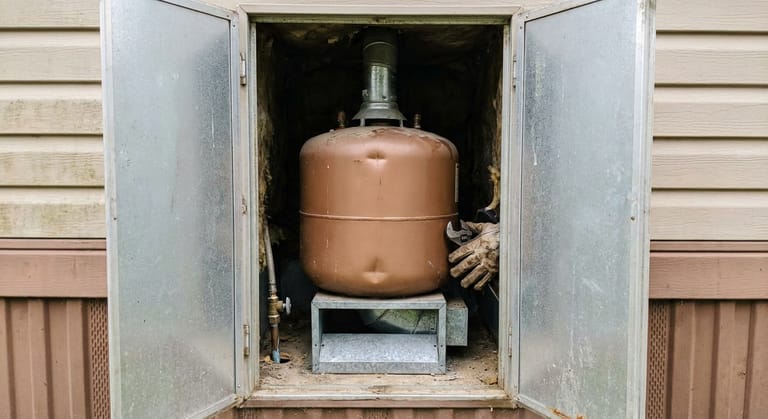
Direct vent or atmospheric, and how to read your own
A. O. Smith's manufactured housing manual is blunt about the sealed side: the certification these heaters carry is direct vent, sealed combustion, so no draft diverter goes on one. Its air arrives from outside through a furnished 3 inch intake, 4 inch on the 50 gallon body, which is why the tank stands on a sheet metal duct assembly, not the deck.
An atmospheric model breathes from the space around it, so it complies only inside that closed compartment. Reliance keeps the limit in plain sight: its product pages claim HUD compliance for manufactured housing, then asterisk it, no inside closet where the design has to be direct vent.
Atmospheric units carry one feature worth naming. Let flammable vapor build up around a Richmond or Rheem manufactured housing atmospheric model and its air and fuel shut-off device takes the heater out of service. No filter in it, so no upkeep.
The answer is printed on the appliance. Clearances, input rating and lighting instructions must survive on the unit as long as the nameplate does, 3280.712 asks that much, and a separate marking permanently names the fuel it is listed for. Photograph that plate first.
Mobile home water heater venting is its own parts list
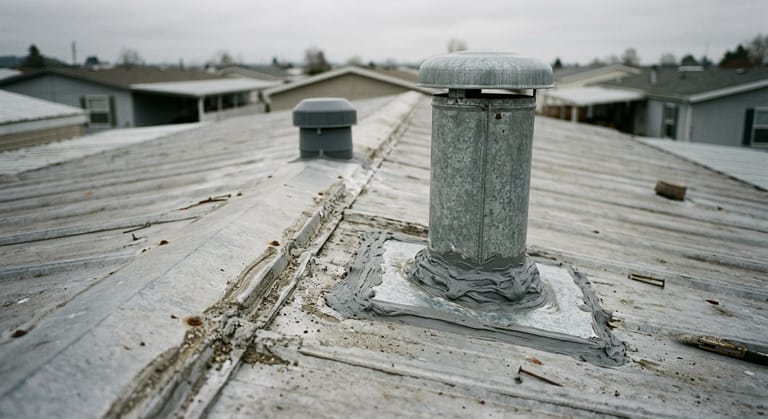
Nothing off the residential vent shelf belongs here. Two builds pass 24 CFR 3280.710: the vent the appliance was certified with as one piece, or a stack whose every part, roof jack included, carries its own listing. Part 3280 carries UL 311 for those jacks and UL 307B for gas burning appliances, both written for manufactured homes.
Three lines from 3280.710 that get broken. The space beneath the home is barred as a vent termination, without exception. Second, height: a motor driven air intake feeding habitable rooms within 10 feet of the vent forces the vent to end 3 feet higher at minimum. Third, a home whose vent came apart for the road wears a permanent label on the appliance saying do not run it until the missing sections are back. Hunt for it on a home that has been moved.
The roof kit is a separate order sized to the run. A. O. Smith lists four of them, with the openings cut at 5 1/2 inches.
| Roof jack kit | Vent length |
|---|---|
| 9002964005 | up to 12 in. |
| 9002965005 | 18 to 32 in. |
| 9002966005 | 32 to 60 in. |
| 9002967005 | 36 to 95 in. |
Anyone pricing a mobile home direct vent kit for a home gas water heater needs one measurement first, top of the jacket to the roof. Taking it is owner work; cutting and sealing the jack over a live burner is not.
Sizes, inputs and what comes out hot
| Nominal | Direct vent | Atmospheric | Recovery and first hour | Diameter |
|---|---|---|---|---|
| 30 gal | 30,000 BTU | 35,500 BTU | 31 GPH, 60 gal (FMDV-30) | 18 in. |
| 40 gal | 32,000 BTU | 35,500 BTU | 59 gal, atmospheric (6-40-NOMT) | 20 in. |
| 50 gal | 40,000 BTU | not listed | 39 GPH, 67 gal (FMDV-50) | 22 in. |
Inputs from the Reliance 2026 spec sheet, the rest from A. O. Smith model pages.
A 40 gallon gas water heater for a mobile home is the middle row and the usual replacement, though 20 inches of girth already jams a tight opening.
Read first hour ratings before gallons. Reliance rates its atmospheric 6-30-NOMT at 63 gallons in the first hour and the bigger 6-40-NOMT at 59, so the smaller tank hands over more during the morning rush. Geometry, not capacity.
Diameter is the harder wall. Going 30 to 50 gallons adds 4 inches of tank and steps the air duct up an inch, so the compartment gets rebuilt around it. Side and back clearances are published at 0 inches, which is why the gallon numbers are only half the measuring.
Talk it through with a mobile home plumber
Call (800) 555-0176Free to dial. You reach a licensed plumber who works on manufactured homes.Partner plumbers who service manufactured homes- Plumbers who actually work on manufactured homes
- Line answered day and night, all year
- Dialing costs you nothing
- Price talk happens between you and the plumber
Propane, natural gas, and the burner in the carton
Every gas mobile home water heater in these lines leaves the factory ready for natural gas, and the propane parts ride along: A. O. Smith packs a complete propane burner with every model, and Richmond's controls convert in the field between natural gas and LP.
Propane inputs sit a step lower: A. O. Smith rates 29,000 BTU on the 30 and 40 gallon direct vent bodies where natural gas gives 30,000 and 32,000. Reliance footnotes a possible drop in first hour rating and recovery too, so a propane water heater for a mobile home trades a little hot water for a fuel you can truck in.
Conversion is regulated. Moving a fuel burning appliance onto a different fuel is something 3280.707 permits only when the job follows the listing and the maker's own instructions.
Elevation limits are brand specific, never a category number: Reliance stops its direct vent models at 5,400 feet and its standard vent models at 10,100, while Richmond certifies a direct vent line to 10,000. Ask before ordering if you sit high, and leave orifice work to the plumber.
The gas line, the shutoff and the connector
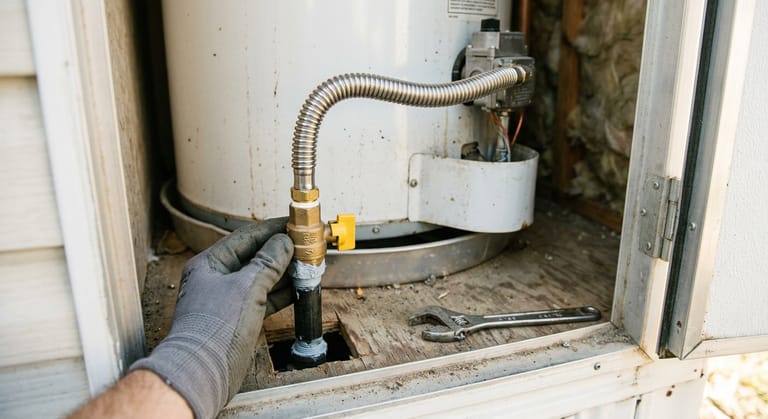
Mobile home gas line installation is not owner work, and HUD is specific about the last few feet of it.
Count two valves, not one. The appliance brings its own; 24 CFR 3280.705 wants a second in the fuel piping at every gas appliance in the home, reachable enough for servicing and for taking components off. On a water heater it sits within 3 feet and is the non-displaceable rotor kind, the ANSI Z21.15 valve.
That same section caps a listed appliance connector at 3 feet, will not let one run through a wall, floor or ceiling, and keeps aluminum ones out of any outdoor location. Part 3280 also carries IAPMO TS 9, the standard for gas supply connectors on manufactured homes.
HomeGuide's national money on the line itself: $350-$2,000 to upsize one, $12-$15 for each linear foot of pipe, $50-$200 at the permit desk.
One step here is yours. Know where that valve is and close it before anything gets disturbed. Threading pipe, sizing the connector and pressure testing belong to a licensed plumber. Any smell of gas ends the reading: get out of the home, then call from outside.
Water connections and where the relief line goes
Reliance states that its mobile home models take water in the side and out the top, and A. O. Smith gives the reason: supply lines arrive under the floor, so the cold inlet is side mounted. On the gas bodies A. O. Smith is blunt that a top mounted T&P is simply not offered, so the relief valve sits low on the side. Richmond's co-axial model breaks the pattern with both connections on top, so side inlets are the tendency here, not a law.
Discharge is the detail that fails inspection. What 3280.609 wants: its own full size pipe, run outside rather than into the space under the home, pointed down, trapped nowhere, ending 6 to 24 inches above finished grade, open end left in view. Swap day in order carries the sequence.
What a gas mobile home water heater costs to replace
2026 national ranges, HomeGuide. Installed swaps run $500 to $1,900 on a 30 gallon, $600 to $3,000 on a 40 and $700 to $3,100 on a 50, with labor alone $200-$1,000 over 2 to 6 hours on a same size job. Then $125-$300 more per labor hour on a difficult install, the closet nobody can reach into being HomeGuide's own example, plus $100-$600 for replacement venting or $500-$1,500 where it goes in the first time.
Repair first while the tank is young. Across 349 member reported projects HomeGuide lands on a $455 average for tank repair, and two jobs keep recurring on burner units: the thermocouple at $100-$325, the control valve at $150-$550. Past ten years, or once a quote climbs to half what a new heater costs, HomeGuide points the money at replacement.
Write five things down, then dial
- The rating plate. Model number, fuel, BTU input, gallons.
- The vent. Sealed pipe with an intake duct beneath the tank, or an open flue.
- Jacket diameter and the narrowest opening it must pass.
- The relief line. Outside, above grade, never into the belly.
- The shutoff. Within 3 feet, and it should still turn.
A gas mobile home water heater is chosen on those five answers, and with them a plumber prices the day by phone. The number is (800) 555-0176, dialing is free, and the line answers at 2 a.m. as readily as at noon. Haverlane publishes and installs nothing. The call goes through to a licensed plumbing partner working in your area, and the cost is settled between you and that plumber.